

AI Robotics Has Stopped Being Mainly a Hardware Story
The important recent advance in AI robotics is not simply that humanoids look more capable. It is that robots are beginning to share reusable models for seeing, planning and acting—while the hard problem of reliability moves into sharper view.
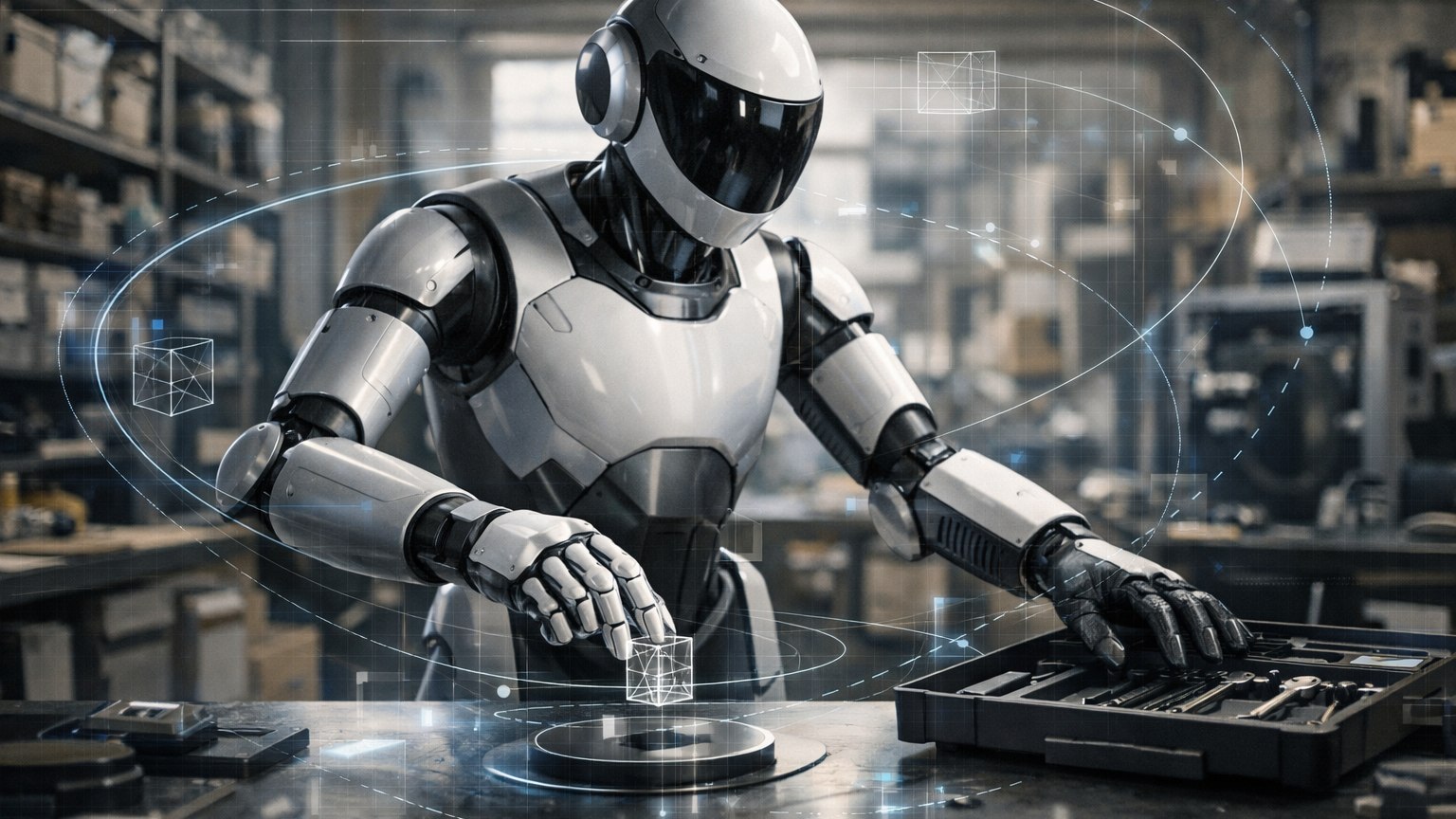
In the most revealing robot demonstrations of 2026, the spectacle is not a humanoid walking across a stage. It is a machine doing something less cinematic and more consequential: looking at an unfamiliar room, interpreting a plain-English request, choosing a sequence of physical steps, recovering when an object is misplaced, and using its body—hands, arms, torso and legs—as one coordinated system. Google DeepMind’s July 2026 announcement of Gemini Robotics 2 presented precisely that ambition: a model family intended to connect high-level reasoning with whole-body robot control, dexterous manipulation, local operation and collaboration among robots.
The headline innovation is therefore not “the humanoid robot” by itself. Humanoid bodies remain expensive, mechanically difficult and often unnecessary. The deeper shift is that robotics is being reorganized around reusable AI systems—models that can connect vision, language and action. If this works at scale, a robot will no longer need to be programmed from scratch for every shelf, package, drawer and workplace. It will still need adaptation, constraints and testing. But the unit of progress becomes a learned capability that can move between tasks and, increasingly, between bodies.
From scripts to vision-language-action
A conventional industrial robot is superb inside a carefully controlled envelope. It can repeat a route or motion with immense precision because the objects, lighting, positions and timing have been engineered around it. AI robotics aims at the opposite problem: how a machine can act when the world is not laid out in advance. The central architecture is often called a vision-language-action model, or VLA. It takes camera input and a linguistic instruction—such as “put the fragile items into the box”—and produces motor actions rather than merely a text answer.
This is a real conceptual break. An ordinary language model can describe how to load a dishwasher; a VLA must continually turn that description into forces, trajectories and decisions while the plates slide, the cabinet door obstructs its arm, or a person enters the scene. The open research project OpenVLA: An Open-Source Vision-Language-Action Model framed the promise well: robot policies can be pretrained on internet-scale vision-language material plus robot demonstrations, then adapted to new visuomotor tasks rather than built anew each time. The physical world, however, is a much harsher examiner than a chat window. A plausible interpretation of an image is not enough; a robot has to make contact without breaking, dropping or trapping anything.
The new stack: a slow mind and fast reflexes
One notable innovation is the separation of deliberation from reflex. Figure’s Helix, announced in 2025, described a two-speed approach: a vision-language component that interprets a scene and instruction at a relatively slow rate, coupled to a fast visuomotor policy that adjusts movement in real time. Google’s current robotics work makes a similar division between an embodied-reasoning model for multi-step planning and a VLA for physical execution.
That division matters because robot intelligence has two clocks. At the slower clock, a system needs to infer that the mug is behind the cereal box and that clearing the counter requires opening a cabinet before placing anything inside. At the faster clock, it needs to react when its fingers meet the mug handle a centimeter off from expectation. Trying to make one model perform both jobs at one tempo can be inefficient and brittle. The emerging answer is not a single magical robot brain, but an ensemble: planner, perceptual system, action policy, conventional safety controller and hardware-level reflexes.
It also changes what “general-purpose” should mean. The most credible version is not a robot that can do everything a person can. It is a machine that can bring a broad prior understanding to a new task, then learn the local details quickly. Google says its on-device model can adapt to new bi-arm embodiments with a few hours of adaptation data, while NVIDIA’s current Isaac GR00T workflow similarly emphasizes post-training a pretrained policy for a particular body, task and setting. This is closer to hiring an experienced worker who still needs site-specific training than to discovering a universal mechanical mind.
Data is becoming the real factory floor
Robots do not acquire common sense simply because a model has seen vast quantities of web text. Human video can suggest what “opening a drawer” looks like, but it does not tell a robot exactly how much torque its own motor must apply or what a handle feels like at contact. The frontier is therefore a mixture of three imperfect data sources: video of people, simulation, and demonstrations collected on actual robots. Each compensates for what the others cannot supply.
Simulation has become especially important because real robot data is slow, costly and sometimes unsafe to collect. NVIDIA’s GR00T-Dreams work describes generating synthetic robot trajectories from generative world models, then using them to train or post-train control policies. The appeal is obvious: a robot can experience variations of a cluttered workbench, a shifted object or an unusual approach angle without physically resetting a laboratory thousands of times. The limitation is equally obvious: generated experience is only valuable insofar as it survives contact with real friction, sensor noise, deformable materials and human unpredictability.
This makes robotics less like traditional automation and more like a data-production industry. Teleoperation—where a person guides a robot remotely—has become a way to collect demonstrations. Motion-capture-like systems, egocentric video and digital twins supplement it. The strategic asset is not only a strong arm or an agile hand; it is a feedback loop that can turn every supervised task, carefully screened failure and simulated variation into better future behavior. In that sense, the factory of the next robot age may first be a factory for experience.
Embodiment is becoming portable
Another important development is cross-embodiment learning: the attempt to transfer useful competence across machines with different shapes, sensors and joints. A model trained on one two-armed system may not directly control another; its wrists, cameras, reach and grippers can be radically different. But it may still carry transferable concepts: where to grasp a cup, which objects are likely containers, why a drawer must be pulled before its contents can be reached, and how to organize a multi-step task.
This is why recent work speaks so often about “robot foundation models.” Physical Intelligence’s π0: A Vision-Language-Action Flow Model for General Robot Control presented a model trained across data from multiple robot types and designed to output low-level motor commands. Its significance is less any one demo than the wager behind it: that robot learning can build a shared base of physical skills, much as large language models built reusable linguistic representations. It is an ambitious wager, not a settled result. Bodies matter. A policy that understands a task may still fail because its hand lacks the necessary degrees of freedom or because its camera cannot see the relevant contact point.
That caveat helps explain a counterintuitive near-term outcome: AI robotics may make specialized machines more useful before it makes humanoids commonplace. A fixed arm at a packing station, a mobile manipulator in a warehouse or a purpose-built inspection robot can benefit from natural-language interfaces, richer perception and learned recovery behavior without taking on the full challenge of bipedal balance in a busy home. Human-shaped robots are compelling partly because our buildings and tools are human-shaped; they are not automatically the best engineering answer to every job.
The bottleneck is now trust, not imagination
The striking thing about this moment is that capability demonstrations are arriving faster than dependable evaluation. A 2025 benchmarking study, Benchmarking Vision, Language, & Action Models on Robotic Learning Tasks, found substantial variation across tasks and platforms and reported that the evaluated models struggled with complex manipulation requiring multi-step planning. NIST likewise notes that manufacturing robotics demands attention to cost, safety and productive output, and is working on measurement approaches for AI models in that setting through its Physical AI and Data Generation for Robotics program.
This is not a footnote. In embodied AI, an error can mean a crushed box, a stalled production line, a damaged tool or an unsafe interaction with a person. The relevant question is not whether a robot can complete a task in a polished clip. It is how it behaves on the 47th attempt, when the lighting changes, the item is dented, the network drops, a human gives an ambiguous instruction, and the system recognizes that it should stop. The most consequential innovation may therefore be mundane but essential: better failure detection, calibrated uncertainty, safety envelopes, audit trails and evaluations that measure recovery rather than only first-pass success.
AI robotics is moving toward a new bargain. We may get machines that need less explicit programming and can contribute in less structured environments. In return, society will need to become much more precise about where autonomy is earned. The future will not be decided by the first robot that looks impressively human. It will be decided by the systems that can reliably admit what they do not know—and hand control back before a clever guess becomes a physical mistake.
Sources and references
- Gemini Robotics 2 brings whole body intelligence to robots
- OpenVLA: An Open-Source Vision-Language-Action Model
- Helix: A Vision-Language-Action Model for Generalist Humanoid Control
- Develop Humanoid Robot Policies End-to-End with NVIDIA Isaac GR00T
- Enhance Robot Learning with Synthetic Trajectory Data Generated by World Foundation Models
- π0: A Vision-Language-Action Flow Model for General Robot Control
- Benchmarking Vision, Language, & Action Models on Robotic Learning Tasks
- Physical AI and Data Generation for Robotics
More to read

The Attack Surface in Your Chat Window: How Ordinary Users Can Think About AI Security
Generative AI changes what a chat window can see, remember and do. A guided workday shows where ordinary choi…

Earth’s Oldest Witnesses Are Not Rocks, but Grains of Sand
Tiny zircon crystals have outlived the landscapes that formed them. Their chemical archives offer a startling…

Acupressure, Meridians and the Art of Useful Touch: 10 Traditional Points to Know
Acupressure is a needle-free practice rooted in Chinese medicine’s channel theory. Here is its long history, …
Apps to use

Hexamgram of Time
Generate a six-line hexagram from the current time or any two numbers and explore the symbolic meaning of its…

Video Mixer
Search stock videos, stream clips continuously, add your own music, and render custom video compilations dire…

Omina Foods
Explore over 2,100 foods with detailed nutritional information, searchable categories, and reliable data from…