

The Afterlife of the Unlived: Do Forgotten Possibilities Still Exist?
An unrealized future can vanish from memory, paper and testimony. But does that erase it completely—or does its brief power to shape decisions, places and relationships leave it with a different kind of reality?
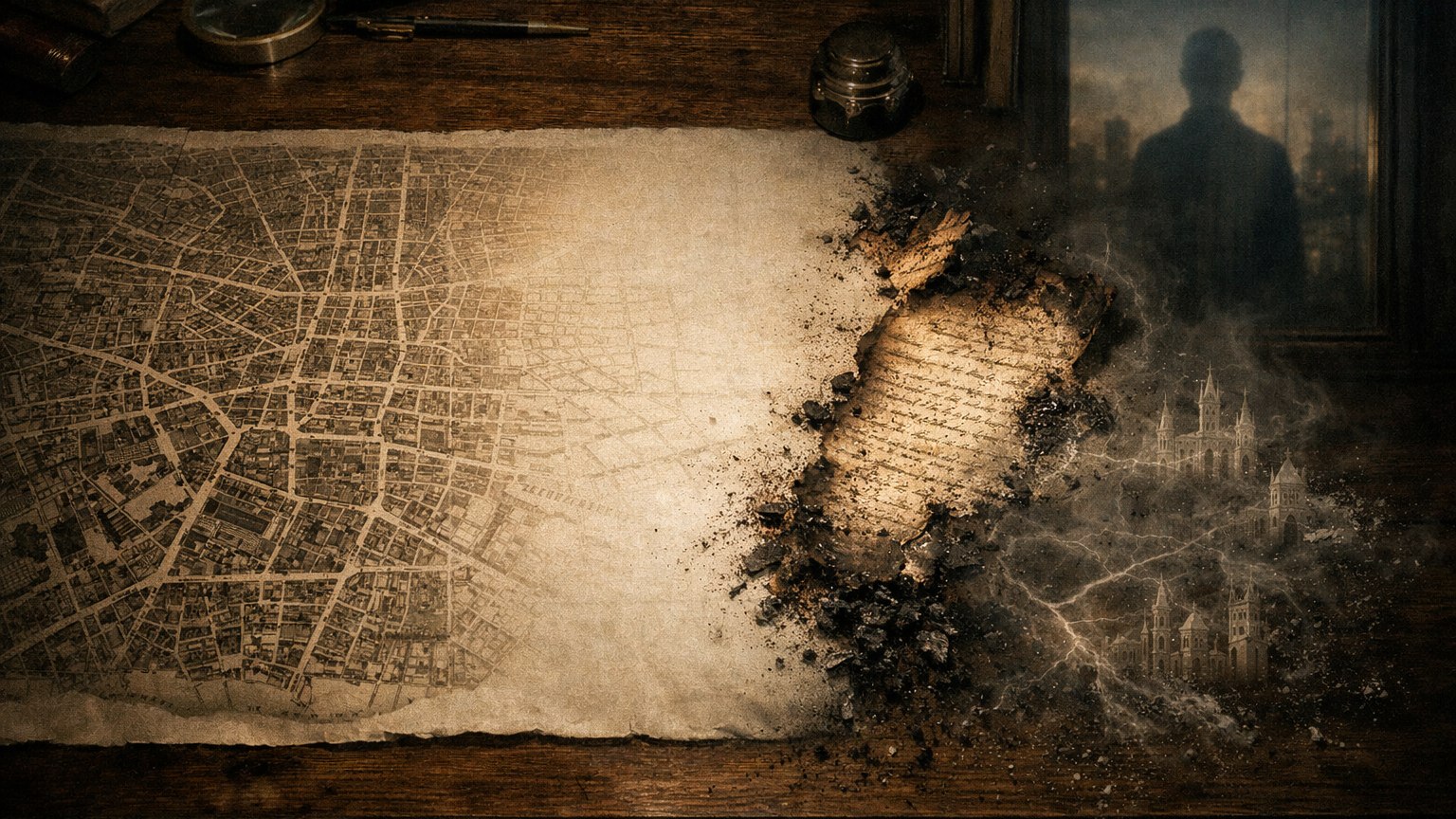
A manuscript is burned. Not merely unpublished: every copy is gone, its author dead, its title forgotten, its existence unknown to anyone alive. Did that book cease to exist in every meaningful sense? The obvious answer is yes. There is no object to read, no idea to recover, no memory in which it survives. Yet the question becomes stranger if the author spent years writing it, declined other work because of it, alienated a friend in an argument over it, or moved to a different city in pursuit of the life it imagined. The book did not become actual as a public work. But while it was entertained, it reorganized an actual life.
This is the central difficulty with unlived possibilities. We tend to treat them as simple absences: the migration not undertaken, the hypothesis not pursued, the marriage not entered, the city not built. But an unrealized possibility can have at least three different careers. First, it can exist as a plan, image, description or expectation held by somebody. Second, while it is held, it can alter choices, habits, relationships, drafts, budgets and landscapes. Third, its representations and traces can disappear. The philosophical question is not whether the future occurred. It did not. It is whether total forgetting makes the possibility itself nothing—or whether it was, for a time, a real part of the world’s becoming.
Three things that should not be confused
Consider a family that debates emigrating. They learn a language, save money, stop repairing a house they expect to leave, and perhaps postpone a child’s education. Then illness, war or simple fear ends the plan. Decades later, no letter, photograph or story preserves it. There are three distinct things here: the migration that never happened; the family’s thought of migrating; and the effects produced by that thought. The first is nonactual. The second was an episode in actual minds. The third may be woven into the later world, even if nobody can identify it as such.
That distinction protects the discussion from a comforting mistake. To say that an unrealized future had consequences is not to say that the future itself occurred in a shadow form. No one crossed the ocean merely because a suitcase was bought. Still, it would be equally mistaken to say that nothing happened. The possibility was not a ghostly event in another country; it was a present orientation toward a future that changed the available present.
Psychology gives this orientation a familiar form. Counterfactual thinking concerns mental representations of alternatives to past events—thoughts commonly expressed as “if only” or “what if.” Kai Epstude and Neal Roese’s review connects such thought with goals, emotion and behavior regulation. That is evidence about cognition, not evidence that alternative histories occupy a hidden realm. But it helps explain why a lost future can retain emotional and practical force: minds represent not only what happened, but what might have happened. The Functional Theory of Counterfactual Thinking
Does possibility need a place to be?
One answer comes from actualism, a family of metaphysical views according to which reality contains only actual entities, rather than nonactual individuals or objects. On a strict actualist picture, there are no nonactual people, books or cities waiting elsewhere in being. There is only the actual world, including actual minds that represent alternatives. A forgotten migration plan, on this view, would not persist as a plan after all minds and records had vanished. What might persist is its actual causal aftermath: a house left unrepaired, a relationship changed, an inheritance distributed differently. The Possibilism-Actualism Debate
Possibilism offers a more expansive family of views. In broad terms, it allows that there may be entities or states of affairs that are possible without being actual—what philosophers call mere possibilia. The appeal is clear: it seems to honor the intuition that there really were ways things could have gone. Its cost is equally clear: what kind of being belongs to a person who was never born, a manuscript never completed, or a city that never rose? The debate contains many versions of actualism and possibilism; it does not produce a settled empirical answer about the ontology of possibilities. The Possibilism-Actualism Debate
At first, possibilism appears to give the forgotten manuscript an easy afterlife. Somewhere in the modal structure of reality, perhaps, there is a world in which it was finished, preserved and read. But this may answer the wrong question. The possibility that mattered to the author was not any abstract world containing a similar book. It was this projected work: entangled with a body, a desk, a particular grief, an argument with a publisher, and a Tuesday afternoon in which the author chose one sentence over another. Modal abundance may preserve a kind of logical availability while losing the intimate historical relation that made the possibility matter.
Another philosophical approach treats possibilities as descriptions, models or contents of thought rather than as extra inhabitants of reality. On that account, “the family might have emigrated” could be true because actual circumstances and capacities made the description apt. This is an interpretation, not a settled metaphysical result. But it suggests that later ignorance need not retroactively alter what people were then able to do. The Possibilism-Actualism Debate
The archive is not just a warehouse
Archives complicate the clean opposition between presence and absence. A surviving map can preserve a city that was never built—not as streets, homes or traffic, but as a legible proposal capable of entering later interpretation. Fondation Le Corbusier documents Le Corbusier’s Plan Voisin as a project for Paris from 1925. Its surviving drawings do not make its proposed city actual; they make the proposal available for study and argument. Fondation Le Corbusier: Plan Voisin, Paris, France, 1925
Material traces can carry a possibility without explicitly naming it. A foundation dug for an abandoned extension, a half-edited scientific paper, a changed route through a neighborhood, or a habit acquired for a departure that never came can be residues of futures that failed to arrive. They are not complete archives, and they may not establish one definitive interpretation. Still, the thought experiment suggests a modest point: human environments may be shaped not only by completed intentions, but also by interrupted ones.
A destroyed manuscript sharpens the point. The Grolier Club records that Lord Byron’s unpublished memoirs were burned in London on May 17, 1824. The surviving account permits mourning, speculation and argument about a text that cannot now be read. If that testimony too were erased, the work would no longer be historically recoverable. It would not follow, however, that its composition or destruction had never occurred. Byron’s Memoirs
Now take the more severe case: not a famous destroyed manuscript, but one whose loss leaves no witness at all. Here the archival account reaches its limit. There may be no remaining basis for saying, historically, that the possibility existed. We should not manufacture lost intentions merely because absence feels tragic. The lack of evidence is an epistemic limit—a limit on what can responsibly be claimed—not necessarily a metaphysical verdict on what may once have occurred in thought.
The future someone once faced
Existential accounts begin elsewhere. They ask not whether a possibility has an independent metaphysical address, but what it means for a person to stand in relation to it. A future matters because it organizes a life before it arrives. The musician who imagines performing, the scientist who follows an anomaly, the parent who imagines a move: each may live partly through commitments to what is not yet. This is a philosophical interpretation, but it captures why possibility can be more than a neutral item on a cosmic menu. It can become a horizon of significance.
This helps explain why regret can remain intelligible even when no external trace survives. Someone may later say, “I could have become someone else.” The statement need not imply that another fully formed self exists in a parallel world. It can mean that actual capacities, circumstances and commitments once opened a path that structured a person’s sense of self. The loss is not only the absence of an outcome. It is the collapse of a relation: a person was once answerable to a future and is no longer.
There is a haunting extension of this thought. A forgotten possibility may be most real, existentially, at the moment it has become least recoverable. When nobody remembers the unmade migration, no descendant can feel its pull as family history. Yet descendants may inhabit effects associated with earlier decisions: a different neighborhood, a language not learned, a different marriage made possible by staying. They live downstream from a question they cannot ask. This is speculation, but it names a familiar human predicament: consequences can outlast any readable account of the intentions that helped produce them.
The case against giving absence too much dignity
There is an important objection. Calling forgotten possibilities “real” can sentimentalize absence. It can turn every unfinished project into a sacred alternate life, flattening the difference between an intention and an achievement. Worse, it can confuse causal effects with the possibility itself. A canceled bridge may have changed land prices and travel patterns, but those effects belong to actual people and actual decisions—not to a bridge that never existed.
This objection should be accepted as a discipline. An unlived possibility should not receive credit, blame or ontological grandeur merely because it is evocative. An abandoned scientific hypothesis whose central question later reappears independently did not secretly cause the later discovery if no chain of transmission connects them. At most, the recurrence may suggest that some problems are repeatedly generated by the world and by the structure of inquiry.
But the objection does not require the opposite conclusion: that only completed things are meaningful. Meaning is not a prize awarded solely at the finish line. A promise broken, a map never followed or a manuscript lost before publication can matter because actual people oriented themselves around them. Their nonfulfillment is part of what happened.
A thinner, stranger kind of survival
Perhaps the most defensible answer is deliberately modest. Once an unlived possibility is no longer remembered by anyone and leaves no evidence, it may cease to exist as a recoverable object of history, a content of memory or a practical option. An actualist can say there is no leftover possibility-entity; a mind-dependent theory can say its representation has gone. Even possibilism, if accepted, would not automatically preserve the particular human significance of that lost future. The Possibilism-Actualism Debate
And yet it need not have become meaningless in every sense. If it once shaped conduct, then it belongs to the causal and existential prehistory of the world that followed. Not as an invisible completed event. Not as a secret city hidden behind the city we have. Rather, as a vanished orientation—something that was real in its encounter with a person, then dissolved into consequences no longer able to name their source.
The speculative possibility is that reality may be less like a museum of durable objects than a landscape of pressures, some of which leave no readable fossil. What disappears completely cannot be possessed by history. But perhaps history is not only what can be archived. Perhaps it also includes the untraceable openings through which actual lives once passed, briefly, before choosing—or being forced into—one road rather than another.
Sources and references
More to read

The Inner Pass and the Outer Pass: PC6, SJ5, and the Art of Emotional Sovereignty
PC6 Neiguan and SJ5 Waiguan sit on opposite sides of the forearm like two doors in one wall. Read philosophic…

10 Lesser-Known Acupuncture Points: A Map of Crossroads, Reservoirs and Hidden Pathways
Beyond acupuncture’s familiar headline points lies a quieter set of locations that reveal how Traditional Chi…
The Lens That Becomes a Life: How Mental Paradigms Shape What We Notice, Choose and Call “Manifestation”
Our deepest assumptions do not necessarily command the universe, but they can strongly influence perception, …
Apps to use

Fu Hsi's Name Trigram
Discover the trigram hidden within your name and explore its personality traits, strengths, weaknesses, caree…

Fu Hsi's Octogram
Discover your birth trigram, explore your current life phase, and search past or future phases through Fu Hsi…

Chinese Zodiac
Discover your Chinese zodiac animal and element from your birth date, and explore its traditional traits, str…