

When Noon Fell From the Sky: The Forgotten Drama of Public Time
Before time lived silently in phones and wristwatches, cities made it visible: a red ball dropped from an observatory roof, a cannon fired, a clock face commanded a square. The history of public time signals reveals how synchronization became one of modern life’s most intimate forms of shared authority.
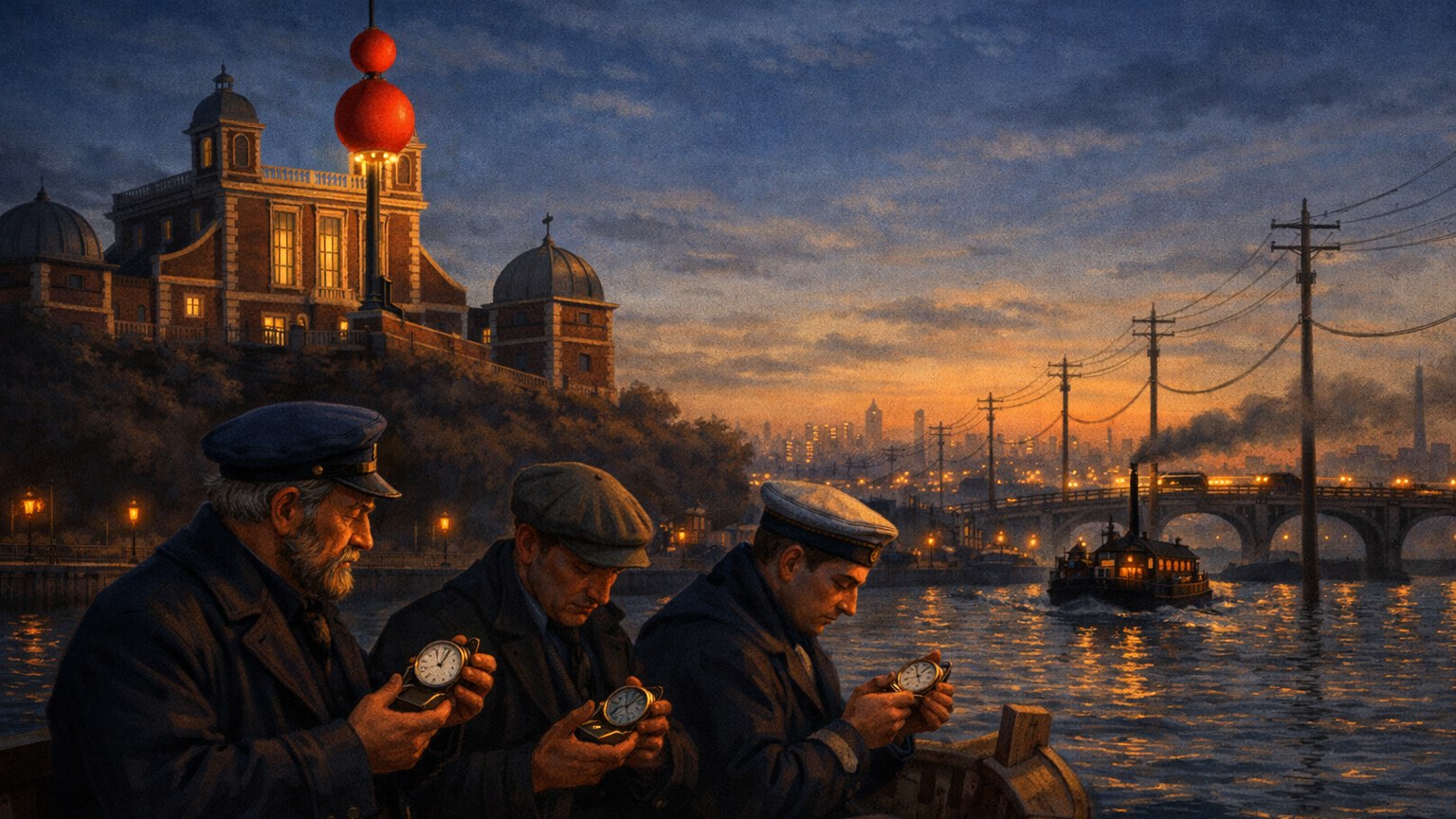
At 12:55 each afternoon, a bright red ball begins to climb the mast above Flamsteed House at the Royal Observatory in Greenwich. At 12:58 it reaches the top; at 1:00 p.m., it drops. The gesture looks quaint beside satellite navigation and networked clocks, yet it preserves a startling idea: time was once something a city had to announce in public. Royal Museums Greenwich, “The Greenwich Time Ball and one time for all”
Before national standard time, towns commonly kept local time by the sun, so clock time could differ from place to place. Installed in 1833, Greenwich’s time ball gave ships and London observers a visible signal for checking their timepieces; it remains in operation today. Royal Museums Greenwich, “History of Royal Observatory Greenwich”
A clock is not just an object. It is a treaty.
We tend to tell the history of timekeeping as a march toward accuracy: sundials gave way to clocks, clocks to watches, watches to phones. But the more consequential change was social. A clock can tell one person an hour; a shared time system lets strangers coordinate meetings, journeys and work. This is an interpretation rather than a scientific claim: modern time can be understood not only as measurement, but as a large-scale agreement about coordination.
Public signals made that agreement theatrical. A time ball offered a visible cue for setting a clock; later, electrical systems could distribute observatory time more widely. The signal did not merely report an hour. It made the authority producing that hour—a naval observatory, a railway company or another public institution—felt in ordinary life. Royal Museums Greenwich, “The Greenwich Time Ball and one time for all”
That is why the time ball’s history is more revealing than it first appears. At Greenwich, an electrical clock system installed in 1852 sent time signals through telegraph wires to stations and buildings around Britain, while a public dial at the Observatory displayed Greenwich Mean Time. Royal Museums Greenwich, “History of Royal Observatory Greenwich”
From local suns to railway time
Local solar time made intuitive sense in a world organized around nearby travel. But railways made differing local times newly conspicuous: in Britain, the growth of rail travel helped drive railway companies toward Greenwich Mean Time, because travelers could otherwise encounter different clock times over relatively short distances. Royal Museums Greenwich, “History of Royal Observatory Greenwich”
In North America, railroads introduced Standard Railway Time on November 18, 1883. The change became known as the “Day of Two Noons” because, in some places, clocks registered noon under the old local convention and then again under the new standard. Congress enacted the Standard Time Act in 1918, giving federal legal force to standard time zones. Library of Congress, “The Day of Two Noons”
There is an easy but misleading story to tell here: that a messy, old-fashioned world was simply corrected by neutral science. Astronomy supplied techniques for determining time, and railways had practical scheduling needs. Yet standard time also asked communities to accept an hour calibrated beyond their own streets. That does not make the change sinister; it makes clear that a standard is not merely discovered. It is adopted, maintained and eventually made to feel natural.
Shared standards are among civilization’s quiet achievements. They reduce the need for continual negotiation over schedules and allow coordination across distance. But the philosophical point is worth preserving: standards are durable social arrangements as well as technical ones.
The strange intimacy of an invisible system
Today, public time is largely hidden. Phones, computers and other digital devices rely on electronic clocks that are periodically corrected through communications infrastructure; NIST describes paths that can connect device time to atomic clocks through cellular networks, GPS and internet time servers. National Institute of Standards and Technology, “Keeping Us On Time”
The U.S. Naval Observatory traces its first public time service to a noon time ball in 1845. It began sending daily telegraph signals in 1865, and a Navy station broadcast worldwide radio time signals based on an Observatory-controlled clock in 1904. U.S. Naval Observatory, “Keeping Track of Time”
The disappearance of spectacle may have changed our relationship with authority. When a ball fell from a mast, the source of official time occupied a building and could be watched. Its contemporary counterparts—reference clocks, satellite systems, telecommunications networks and time servers—are dispersed and usually imperceptible. This is a cultural interpretation, but it helps explain why time can now feel intensely personal even when its reliability depends on collective infrastructure.
The alarm may be mine, and the calendar may appear private, but their usefulness rests on shared conventions. Digital systems can synchronize clocks through common reference times; NIST, for example, distributes time through radio, satellite, telephone and internet services. National Institute of Standards and Technology, “Time Distribution”
What the time ball can still teach us
The surviving Greenwich time ball is not important because it offers a better way to set a watch. It is important as a visible remnant of an era when the distribution of time had to be seen. Its continued daily operation preserves a public ritual once tied to navigation, observation and the wider circulation of Greenwich time. Royal Museums Greenwich, “The Greenwich Time Ball and one time for all”
It also prompts a speculative philosophical question: what else do we mistake for private or self-evident reality because the systems beneath it have become invisible? Money, maps, borders, legal names, calendars and the workweek have material consequences, yet each also depends on shared interpretation and sustained institutional practice. They are not unreal; they are real in the way a promise is real—neither a natural object nor a mere fantasy, but a structure that changes what people can do together.
Standard time belongs in that category. The sun still crosses each local sky on its own schedule, while modern life is organized around common standards that reach beyond local solar time. The red ball falling at Greenwich remains a modest relic of that bargain: a reminder that one of humanity’s most powerful technologies is not the clock alone, but the capacity to agree on what its hands mean.
Sources and references
More to read

The List Is Not the Tradition: Why Living Heritage Cannot Be Preserved Like a Monument
UNESCO can recognize a ritual, a craft or a musical tradition—but recognition is not the same as keeping it a…

If You Don’t Hear an Inner Voice, Who Is Doing the Thinking?
The discovery that inner speech varies radically from person to person unsettles a familiar assumption: that …

The Lens That Becomes a Life: How Mental Paradigms Shape What We Notice, Choose and Call “Manifestation”
Our deepest assumptions do not necessarily command the universe, but they can strongly influence perception, …
Apps to use

Chinese Zodiac
Discover your Chinese zodiac animal and element from your birth date, and explore its traditional traits, str…

Video Forge
Upload one or more images, add your soundtrack, and bring everything to life with customizable motion and vis…

MIDI Art Studio
Transform images into musical art! MIDI Art Studio converts pictures, logos, and drawings into colorful piano…