

Earth’s Oldest Witnesses Are Not Rocks, but Grains of Sand
Tiny zircon crystals have outlived the landscapes that formed them. Their chemical archives offer a startling route into Earth’s first half-billion years—and a lesson in how science reconstructs worlds that no longer exist.
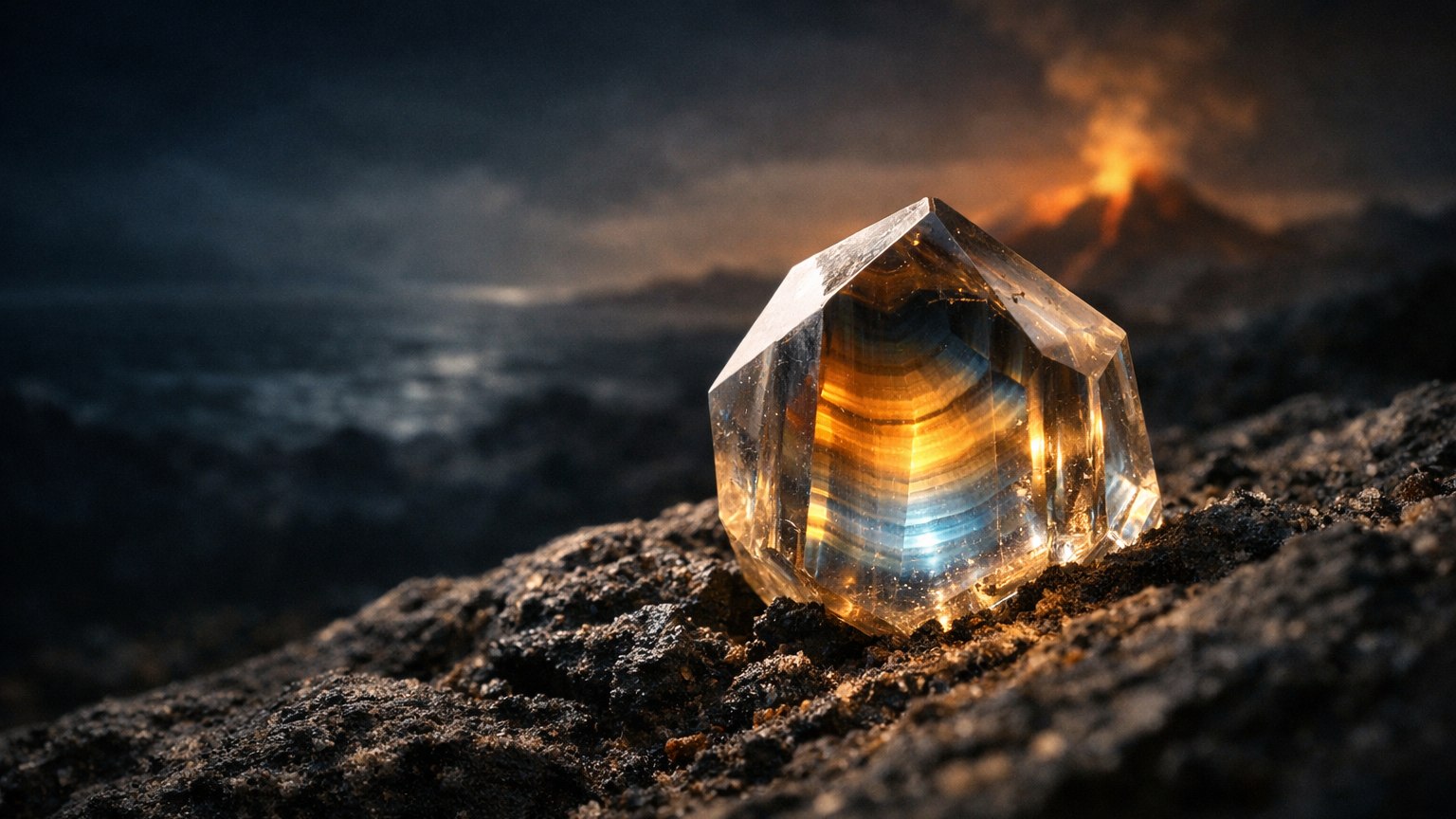
Some of the most consequential evidence about the young Earth can fit beneath a fingernail. In Western Australia’s Jack Hills, geologists have found zircon crystals that are more than 4.3 billion years old—far older than any intact rock from the same period. These grains are not relics sitting politely inside their original landscape. They were weathered out of older rocks, swept into sediments, buried, heated, and preserved in younger rock. The landscape that made them is gone. The crystal remains. USGS, “Geologic Time: Age of the Earth”
That makes zircon an unusually strange kind of witness. A fossil tells us that an organism once lived; a zircon can suggest that a mountain, a magma chamber, an ocean, or perhaps an early crustal environment once existed—even when the physical setting has been erased. The central curiosity is not simply that these crystals are old. It is that they force geology to become a form of historical reconstruction from fragments: not archaeology with ruins, but archaeology after the ruins have themselves been recycled into the planet.
A mineral built to outlast its world
Zircon is zirconium silicate, ZrSiO₄, a mineral that commonly crystallizes from magma. It is exceptionally useful to geologists because it can incorporate uranium atoms into its crystal structure while largely excluding lead when it forms. Over time, uranium decays into lead at known rates. Measuring the parent and daughter isotopes therefore allows researchers to calculate crystallization ages using uranium-lead dating. Zircon is also chemically durable enough to survive weathering, transport, metamorphism, and sometimes even partial melting that would obliterate much of the rock around it. USGS, “Uranium-Lead Geochronology of Proterozoic Rocks in Central New Mexico” USGS, “Time’s Ruler”
That durability creates an almost paradoxical archive. A zircon grain may be older than the sandstone that contains it, older than the mountain range from which that sandstone was later uplifted, and older than most of the continental crust nearby. It is a traveler rather than a native. Calling it a “time capsule” is useful, but incomplete: a capsule is sealed and stationary. Zircon is more like a message in a bottle that has crossed several oceans, been buried under a continent, and still retained a legible part of its note.
The oldest known Jack Hills zircons approach the opening chapters of terrestrial history. One influential study reported a grain dated at 4,404 ± 8 million years, and interpreted its oxygen-isotope chemistry, mineral inclusions, and evolved composition as evidence consistent with continental crust and interaction with liquid water at that extraordinarily early date. The conclusion mattered because the Hadean eon is often imagined as a uniformly infernal interval. These grains implied that at least some parts of early Earth may have cooled, differentiated, and cycled water sooner than a simple global-magma-ocean image suggests. Wilde et al., “Evidence from detrital zircons for the existence of continental crust and oceans on the Earth 4.4 Gyr ago”
How a crystal stores more than an age
A date alone says only when a portion of a crystal formed. Zircons become historical documents because researchers can also examine their internal zoning and trace-element or isotope signatures. Under a microscope or ion beam, a single grain may reveal distinct growth stages: a core formed in one magmatic episode and an outer zone formed later. Oxygen isotopes can help constrain whether source material interacted with water near Earth’s surface; hafnium isotopes can help researchers investigate the relation between newly derived mantle material and reworked crust. These are not direct photographs of vanished oceans or continents. They are constrained chemical clues, and their meaning depends on models of how rocks melt, mix, alter, and crystallize. USGS, “Time’s Ruler” Johnson et al., “Giant impacts and the origin and evolution of continents”
This distinction is more than scientific caution. It changes the romance of the story. The remarkable thing about a 4.4-billion-year-old zircon is not that it provides a final answer about the first continents. It is that it lets a present-day scientist make a disciplined argument about a world for which there is almost no surviving scenery. Its evidence is indirect, but not vague. A grain’s isotopes narrow the range of possible histories; other observations test whether one interpretation fits better than another.
And the arguments genuinely remain open. Research on the Acasta Gneiss Complex in Canada, the oldest precisely dated Hadean rock unit, found no indication that its material had interacted with older Hadean continental crust. That does not make the Jack Hills zircons irrelevant or false. It means early Earth may not yield to a single, global story. A few ancient grains may record local conditions, episodic environments, or crust that was later destroyed, rather than a planet already arranged like the modern one. Reimink et al., “No evidence for Hadean continental crust within Earth’s oldest evolved rock unit”
The danger of treating deep time as a detective novel
There is a temptation to turn every ancient chemical signal into a tidy revelation: water existed, continents existed, plate tectonics began, life became possible. But the further back the evidence reaches, the more inference matters. Zircon data are powerful precisely because they preserve information through destruction; they are difficult because the original context is missing. A detached grain can tell us something about its parent material without telling us exactly where that material sat, how extensive it was, or how long its environment lasted.
This is why competing interpretations are a strength rather than an embarrassment. One recent study of the Pilbara Craton used dated magmatic zircons and oxygen-isotope data to propose that giant impacts helped shape an early continental nucleus in stages. That is a striking hypothesis, not a recovered movie of the Archean Earth. Its value lies in making a physical mechanism testable against chemical evidence, impact records, and comparable rock histories. Johnson et al., “Giant impacts and the origin and evolution of continents”
The deeper lesson is that evidence does not need to be complete to be meaningful. It needs to be interpreted at the scale it can bear. A zircon can support an argument about the conditions under which it crystallized; it cannot, by itself, settle the climate of an entire planet. This boundary is where curiosity becomes more interesting than certainty. Instead of asking whether a crystal “proves” a lost world, we can ask what worlds remain possible after the crystal has spoken.
A philosophy of fragments
There is a quietly radical implication here. We tend to think that the past is stored in large things: monuments, skeletons, strata, archives, cities. Zircons suggest another possibility. Sometimes the longest memory belongs to the smallest object, not because it has remained untouched, but because it has endured transformation without surrendering every trace of its origin.
That is not merely a geological metaphor. It invites a more careful idea of continuity. To survive is not always to stay in place. A zircon survives by leaving its first home, entering another rock, and becoming evidence for a reality it can no longer physically show us. The grain does not preserve the lost landscape intact. It preserves a constraint upon our imagination: whatever story we tell about early Earth must make room for this impossible-seeming survivor.
Earth’s oldest witnesses are therefore not miniature history books. They are harder and more valuable than that. They are questions with atomic structure—questions that have lasted through oceans, mountains, impacts, and the recycling of continents. Their real wonder is not that they make deep time feel solved. It is that they make deep time, briefly and rigorously, available to thought.
Sources and references
- Geologic Time: Age of the Earth
- Uranium-Lead Geochronology of Proterozoic Rocks in Central New Mexico
- Time’s Ruler
- Evidence from detrital zircons for the existence of continental crust and oceans on the Earth 4.4 Gyr ago
- No evidence for Hadean continental crust within Earth’s oldest evolved rock unit
- Giant impacts and the origin and evolution of continents
More to read

The Accidental Museum in Your Air Filter
A used HVAC or air-purifier filter is not merely grimy refuse. It is a biased, time-blurred sample of particl…
The Library That Must Never Be Opened
At Herculaneum, some of the most precious books from the ancient world survive as blackened, tightly wound cy…
10 Lesser-Known Acupuncture Points: A Map of Crossroads, Reservoirs and Hidden Pathways
Beyond acupuncture’s familiar headline points lies a quieter set of locations that reveal how Traditional Chi…
Apps to use

Music Visualizer
Turn any song into dynamic, beat-reactive visuals with spectrum bars, radial effects, waveforms, particles an…
Breath & Frequency Trainer
Train your breathing with guided patterns, synchronized geometric visuals, and optional frequency tones for m…

Video Converter
Convert videos between popular formats directly in your browser — privately, locally, and without uploading y…