

If You Don’t Hear an Inner Voice, Who Is Doing the Thinking?
The discovery that inner speech varies radically from person to person unsettles a familiar assumption: that the self is the voice in our head. What if the voice is not the author of thought, but one of thought’s instruments?

Ask people to “listen to their thoughts” and many will report a running commentary: a voice rehearsing conversations, issuing reminders, arguing cases, narrating embarrassment. Ask others the same question and you may receive a puzzled look. They may think in images, bodily pulls, scenes, spatial relations, fragments of language—or in something they find difficult to translate into any private soundtrack.
This difference has acquired a provocative name. In 2024, psychologists Johanne Nedergaard and Gary Lupyan used anendophasia for the reported absence or near-absence of inner speech, and compared people reporting high and low levels of inner speech across several tasks. Their study found group differences on verbal working-memory and rhyme-judgment tasks, while other tasks did not show the same pattern. The result is intriguing, but it does not establish a clean new human type: a later commentary argued that self-reports of infrequent inner speech are not the same thing as proof that someone never experiences it. Nedergaard and Lupyan (2024); Lind (2025).
Still, the question opened by this research is larger than the terminology. If a person can deliberate, recognize a friend, feel remorse, make plans, fall in love, solve a problem and sustain a life without much audible thought in words, then the familiar inner narrator cannot simply be identical with the mind. It may be important. It may be useful. But it is not obviously the sovereign.
The voice feels like the self because it speaks in the first person
Inner speech has a peculiar authority. It says “I should,” “I remember,” “I cannot,” and because it uses the grammar of ownership, we easily mistake it for the owner. A sentence appears—I am failing—and its verbal form gives it the dignity of a verdict. Yet a sentence is also an event. It arrives, changes the atmosphere of experience, and may be revised by another sentence minutes later.
The Russian psychologist Lev Vygotsky treated inner speech not as a tiny announcer seated inside the skull but as a changing process between language and thought. In his account, external speech turns thought into words for others; inner speech moves in the opposite direction, compressing words into highly personal meanings. He stressed that thought and word are intertwined without being identical. Vygotsky, “Thought and Word”.
That distinction matters existentially. If thought and language are not identical, then the inner monologue is less like a king giving orders than a translation layer: one format in which a deeper, more distributed activity sometimes becomes available to itself. The voice may be where impulse, memory, social learning and imagination become discussable. It is a remarkable invention. But an invention need not be the inventor.
What if the narrator is a witness created by consciousness?
Here is the proposition worth taking seriously: perhaps consciousness does not contain a single author who produces thought, but produces an author-shaped experience whenever its processes become verbally legible.
On this view, the voice in the head is neither fake nor trivial. It is a practical character generated by a living system that must coordinate commitments across time. It can remember promises, simulate an argument, restrain an impulse and speak to itself in the borrowed tones of parents, teachers, rivals and friends. But its sense of authorship may be retrospective. The narrator often finds a thought already underway and gives it a grammatical home: I think that…
This is not the crude claim that people lack agency or that all decisions are illusions. Agency may be real precisely as an activity of the whole person—body, attention, values, habits, relationships, memory and capacity to revise—not as a miniature executive issuing verbal commands from a control room. The mistake is to search for agency in only the loudest format it takes.
Imagine two people choosing whether to leave a damaging job. One hears an elaborate internal debate, complete with objections and rebuttals. The other experiences a mounting bodily refusal, recurrent images of a different life, and a quiet certainty that words come later to explain. It would be simplistic to declare the first rational and the second irrational. Both may be reasoning. They may simply be reasoning through different media.
The mind may be plural before it becomes personal
This possibility changes the meaning of self-knowledge. Much self-help assumes that insight means finding the correct sentence about oneself: I fear intimacy; I need boundaries; I want a different life. Sometimes it does. But language can also arrive too early, pinning a fluid reality beneath a slogan. A person who has little inner speech may never have had the luxury—or the trap—of mistaking verbal fluency for understanding.
There is a deeper paradox here. We often use inner speech to claim individuality: my private voice, my private story. But the materials of that voice are overwhelmingly inherited. Its language was learned from other people. Its standards and insults may echo old authorities. Even its apparent solitude can be crowded. A review of inner-speech research describes it as linked to self-regulation and notes that it can be experienced in one’s own voice or another person’s voice; it is not necessarily felt as something one actively produces. Alderson-Day and Fernyhough, “Inner Speech: Development, Cognitive Functions, Phenomenology, and Neurobiology”.
That does not make the self a mere social puppet. It suggests something stranger and more generous: a self may be a continuing negotiation rather than a fixed speaker. Identity is not necessarily the voice that says “I.” It may be the pattern that decides which voices are welcomed, questioned, transformed, or allowed to pass without obedience.
Silence is not emptiness
People who report little or no inner voice are often treated as though they have described an absence: no soundtrack, therefore less interiority. But this confuses one channel with the whole broadcast. The nonverbal mind can be full of felt significance. A dancer may know the next movement without narrating it. A designer may sense that a room is wrong before identifying why. A grieving person may carry knowledge too dense for a sentence. In each case, words may clarify the experience—or reduce it.
We might call this the preverbal surplus: the part of a life that is not hidden because it is mysterious, but because language is narrower than living. It includes perception before classification, emotion before explanation, and intention before a plan can be stated. The inner voice is often useful because it converts this surplus into choices another person can understand. Its usefulness should not tempt us to confuse it with the source.
That is also why a quieter inner life should not be romanticized. Silence can contain wisdom, but it can also contain avoidance, confusion or unexamined habit. Verbal reflection remains one of the ways people test a hunch, expose a contradiction and become accountable for a decision. The point is not to overthrow language. It is to stop granting language a monopoly on mind.
A better question than “What is my inner voice saying?”
For people with vivid inner speech, the practical implication is modest but potent: treat the voice as a participant, not an oracle. When it declares catastrophe, ask what else is present—an image, a sensation, a memory, a value, a need for rest, an unspoken social fear. When it offers a brilliant story about who you are, ask whether the story describes experience or merely organizes it.
For people who do not think in a running verbal stream, the implication is equally important: absence of narration is not absence of reflection. Your thought may need drawing, movement, conversation, lists, music, quiet observation, or time before it can become communicable. There is no psychologically mandatory inner format.
None of this is a clinical test. A sudden or distressing change in thinking, perception, mood or functioning deserves qualified professional attention rather than philosophical interpretation. But ordinary variation in inner experience invites a less anxious conclusion: minds need not resemble one another from the inside in order to be equally awake.
The enduring mystery is not whether the voice in the head is real. It is real as experience. The mystery is why consciousness so readily turns some of its own movements into a speaker and then asks that speaker to explain the whole house. Perhaps the self is not the narrator at all. Perhaps it is the larger hospitality in which narration, image, impulse, memory and silence are temporarily allowed to become someone.
Sources and references
More to read

Your Future Self May Be a Committee, Not a Destination
We talk about “becoming ourselves” as though a finished person is waiting ahead. But the mind may be doing so…

The Afterlife of the Unlived: Do Forgotten Possibilities Still Exist?
An unrealized future can vanish from memory, paper and testimony. But does that erase it completely—or does i…

The Inner Pass and the Outer Pass: PC6, SJ5, and the Art of Emotional Sovereignty
PC6 Neiguan and SJ5 Waiguan sit on opposite sides of the forearm like two doors in one wall. Read philosophic…
Apps to use
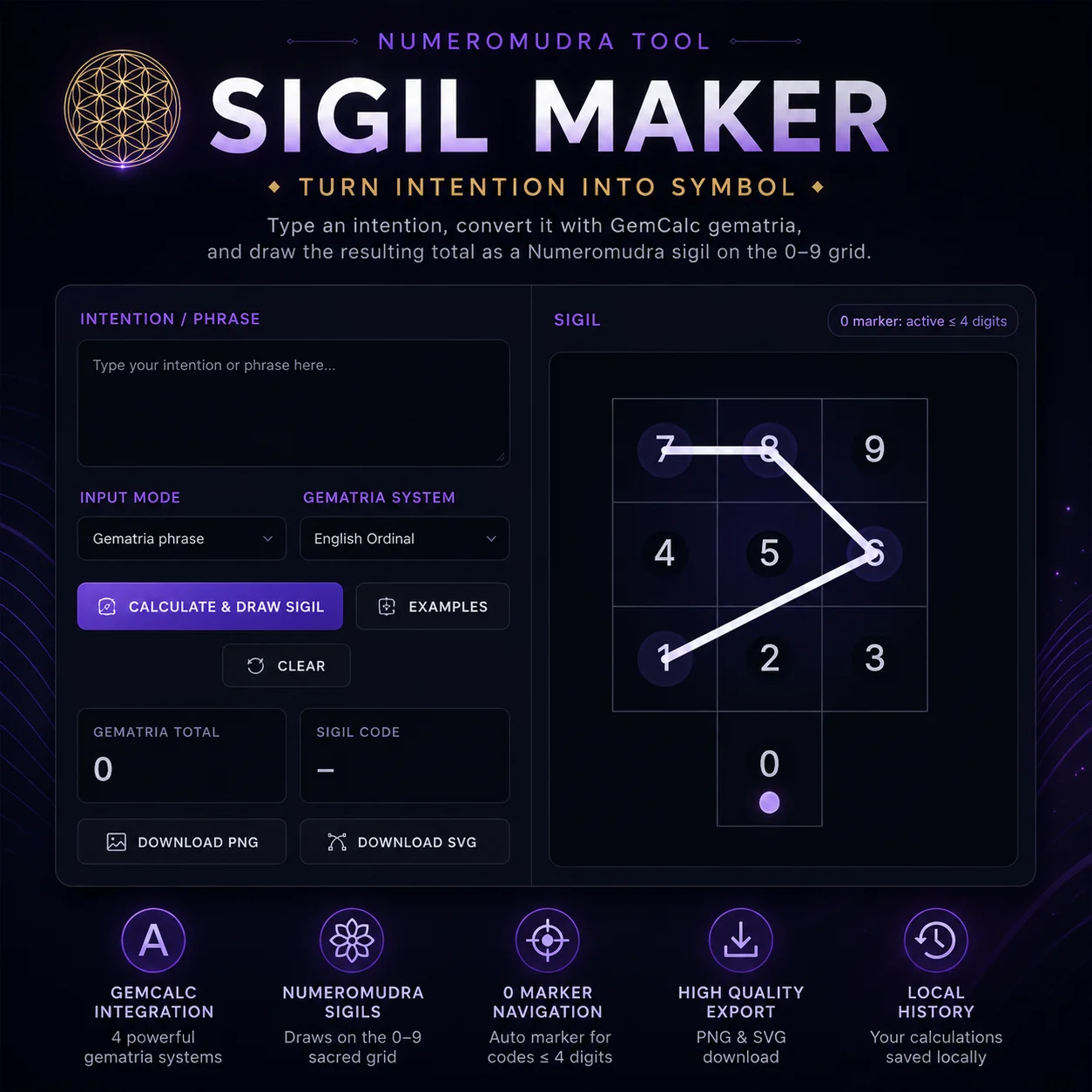
Sigil Maker
Turn words, intentions and number sequences into unique visual sigils using Gematria and the Numeromudra 0–9 …

Birthday Grid
Turn any birthdate into a visual numerology grid. Birthday Grid reveals active numbers, repetitions, complete…

Chinese Zodiac
Discover your Chinese zodiac animal and element from your birth date, and explore its traditional traits, str…