

The Inner Pass and the Outer Pass: PC6, SJ5, and the Art of Emotional Sovereignty
PC6 Neiguan and SJ5 Waiguan sit on opposite sides of the forearm like two doors in one wall. Read philosophically, they offer a striking model of resilience: not a life without disturbance, but an inner harmony paired with a conscious boundary to the world.

Two finger-widths above the wrist, on opposing surfaces of the forearm, traditional Chinese medicine locates a quietly arresting pair: PC6 Neiguan, the Inner Pass, and SJ5/TE5 Waiguan, the Outer Pass. They are not merely near one another. They face one another across the arm: Neiguan on the palmar, or inner, side; Waiguan on the dorsal, or outer, side. Their names make the anatomy feel almost like a diagram of a human problem: how can a person remain inwardly coherent while living in a world that never stops arriving?
In traditional point classification, PC6 belongs to the Hand Jueyin Pericardium channel and is described as a Luo-connecting point and a confluent point of the Yin Linking Vessel. It lies two cun above the wrist crease, between the palmaris longus and flexor carpi radialis tendons. Its name, Neiguan, joins nei—inner—with guan—a gate, pass, or barrier. Classical point descriptions also explicitly place it opposite Waiguan. Neiguan (PC6) - Acupuncture
SJ5, also written TE5 or TB5, belongs to the Hand Shaoyang San Jiao channel. It is likewise a Luo-connecting point and a confluent point, in this case of the Yang Linking Vessel. It lies two cun above the dorsal wrist crease, between the radius and ulna, directly across from PC6. Waiguan means Outer Pass: wai, outer; guan, pass or barrier. Traditional descriptions link its name to its position on the outer, extensor side of the forearm and identify Neiguan as its counterpart. Waiguan (TE5) - Acupuncture
A pair of doors, not a pair of walls
It would be easy to turn this imagery into a simplistic slogan: PC6 protects the inside, SJ5 protects the outside. But doors are more interesting than walls. A wall only excludes. A door distinguishes, admits, delays, filters, and permits departure. It makes relationship possible without making invasion inevitable.
That is the metaphysical possibility contained in this pair: emotional balance may not be the absence of disturbance, but the capacity to preserve an inner order while consciously governing one’s participation in external disorder. The inner pass is not a bunker. The outer pass is not a fortress. Together they suggest a living threshold.
We tend to describe resilience as toughness: the ability to take a blow without breaking. Yet toughness alone has a hidden cost. A person can become so defended that nothing enters—not only insult, manipulation, and noise, but affection, surprise, correction, and wonder. The supposedly resilient self becomes a sealed self. It survives contact by reducing contact.
The Neiguan–Waiguan image proposes something subtler. PC6, the Inner Pass, can stand for the work of restoring accord within: gathering scattered feeling, allowing the heart-mind to return from alarm, resentment, anticipation, or grief to a more inhabitable center. SJ5, the Outer Pass, can stand for the complementary work of discernment: deciding what deserves entry, what may remain at the threshold, and what must pass through without becoming an occupant of the psyche.
The self as a selective threshold
Consider the ordinary experience of receiving difficult news. The event arrives from outside: a message, a look, an accusation, a headline, a memory stirred by another person’s remark. But the event does not become suffering in only one step. It crosses thresholds. First it is perceived. Then interpreted. Then assigned a meaning. Then woven into a story about oneself, the future, other people, or the nature of reality.
At each crossing, there is an opportunity for sovereignty. Not total control—no one chooses every first feeling, and no honest philosophy should pretend otherwise—but participation. The outer pass asks: Must this enter as an authority? The inner pass asks: Having entered, must it govern?
This distinction matters because modern language of “boundaries” can become too external. We imagine a boundary as something set between ourselves and another person: saying no, leaving a room, muting an account, ending a conversation. These acts can be necessary. Yet an outer boundary is incomplete if the rejected voice has already become an inner ruler. One may block the sender and still rehearse their contempt for hours. The outer gate has closed, but the inner pass remains occupied.
Conversely, a person may have a calm interior practice yet no practical boundary: limitless availability, compulsive explanation, constant exposure to outrage, agreement offered to avoid conflict. In that case, inner peace becomes a room with no door. It may feel spiritual, but it cannot remain peaceful for long, because it has no power to determine its conditions of contact.
PC6 and SJ5 therefore invite a paired definition of emotional sovereignty: the freedom to tend one’s inner climate and the freedom to choose the terms on which the world is allowed to shape it. Sovereignty is not isolation. It is authorship of the threshold.
The paradox: openness requires a boundary
Here the two points lead to a deeper paradox. We often assume that openness and protection oppose each other: to be open is to be vulnerable; to be protected is to be closed. But a living organism is neither fully open nor fully sealed. Skin, lungs, attention, language, friendship, and memory all work by regulated exchange. Life depends on permeability with discrimination.
Perhaps consciousness works in a similar way. The self is not an object hidden behind experience; it may be an ongoing act of selection within experience. It gathers some impressions into identity, lets others evaporate, revises inherited meanings, and sometimes discovers that what looked like an external threat was an old interior wound asking to be recognized.
Under this model, the Inner Pass is where a person remembers that feeling is real without being final. Anger can be felt without becoming a verdict. Fear can be heard without becoming a command. Sadness can be honored without becoming a permanent description of the one who feels it. Inner harmony is not emotional blankness. It is the capacity to let an emotion move as a guest rather than enthrone itself as king.
The Outer Pass, meanwhile, is where a person remembers that not everything offered by the world is an obligation. An insult is an event, not necessarily an identity. A demand is a request before it is a duty. A collective panic is information before it is a personal destiny. Even praise, which can be as binding as criticism, may be welcomed without being allowed to dictate one’s next performance.
The strange implication is that personal boundaries are not chiefly lines around the self. They are rhythms of admission. They regulate timing, depth, and consequence. They say: this may touch me, but not define me; this may inform me, but not commandeer me; this may wound me, but it will not be given the final word about who I am.
A small forearm ritual
Used as a contemplative practice rather than a medical intervention, these paired locations can offer a tactile ritual for rehearsing that philosophy. Place gentle, comfortable pressure on PC6, on the inner forearm above the wrist crease. Let the gesture mean: I return to the part of me that can receive feeling without becoming lost in it.
Then turn the forearm and rest gentle pressure on SJ5, at the corresponding point on the outer forearm. Let this second gesture mean: I choose what I will carry forward from this encounter, and what I will allow to remain outside my center.
The sequence need not be elaborate. It may take one minute before a difficult conversation, after reading upsetting news, while commuting home, or in the first surge of an old emotional pattern. Breathe normally. Do not try to force serenity. Name what is present with enough honesty to avoid spiritual theater: “I am angry.” “I want approval.” “I feel invaded.” “I am afraid this will define me.” Then return to the two questions: What needs tending within? What needs regulating at the boundary?
Any energetic or protective effect in this ritual belongs to the philosophical model, not to an established medical claim. Gentle acupressure should also not be used as a substitute for care for persistent physical symptoms, acute distress, or mental-health crises. Its value here is simpler and, perhaps, more durable: the body becomes a memorable place to practice a decision of consciousness.
Beyond defense: the ethics of what we admit
If the inner and outer passes are taken seriously, emotional life becomes an ethics of reception. We are shaped not only by what happens to us, but by the meanings to which we repeatedly grant residency. This does not mean people cause their misfortunes by thinking incorrectly. Events can be cruel, systems can be oppressive, grief can be irreversible, and trauma can exceed the powers of immediate choice. The model concerns the remaining field of agency: the gradual recovery of one’s authority over interpretation, attention, and participation.
It also changes how we think about influence. A boundary is not an accusation against the world. It is a way of meeting the world without demanding that it become harmless. The mature question is not, “How can I make sure nothing disturbs me?” That wish would require a deadened life. The better question is, “How can I remain available to reality without surrendering my interior government?”
PC6 and SJ5, Inner Pass and Outer Pass, offer a compact answer. Harmony within is not passivity. Boundaries without are not hostility. The inner pass receives experience and restores proportion; the outer pass gives experience its proper distance. One lets the world touch us. The other prevents the world from possessing us.
Perhaps the deepest insight is this: the self is not most free when nothing gets in, nor when it can control everything within. It is free when it can turn contact into relationship rather than captivity. The Inner Pass and the Outer Pass then become more than points on opposing sides of an arm. They become a philosophy of the threshold: a reminder that peace is not a world kept out, but a center that remains capable of choosing how the world comes through.
Sources and references
- Neiguan (PC6) - Acupuncture | https://yaozi-intl.com/en/db/?ano=225
- Waiguan (TE5) - Acupuncture | https://yaozi-intl.com/en/db/?ano=233
More to read

The Afterlife of the Unlived: Do Forgotten Possibilities Still Exist?
An unrealized future can vanish from memory, paper and testimony. But does that erase it completely—or does i…
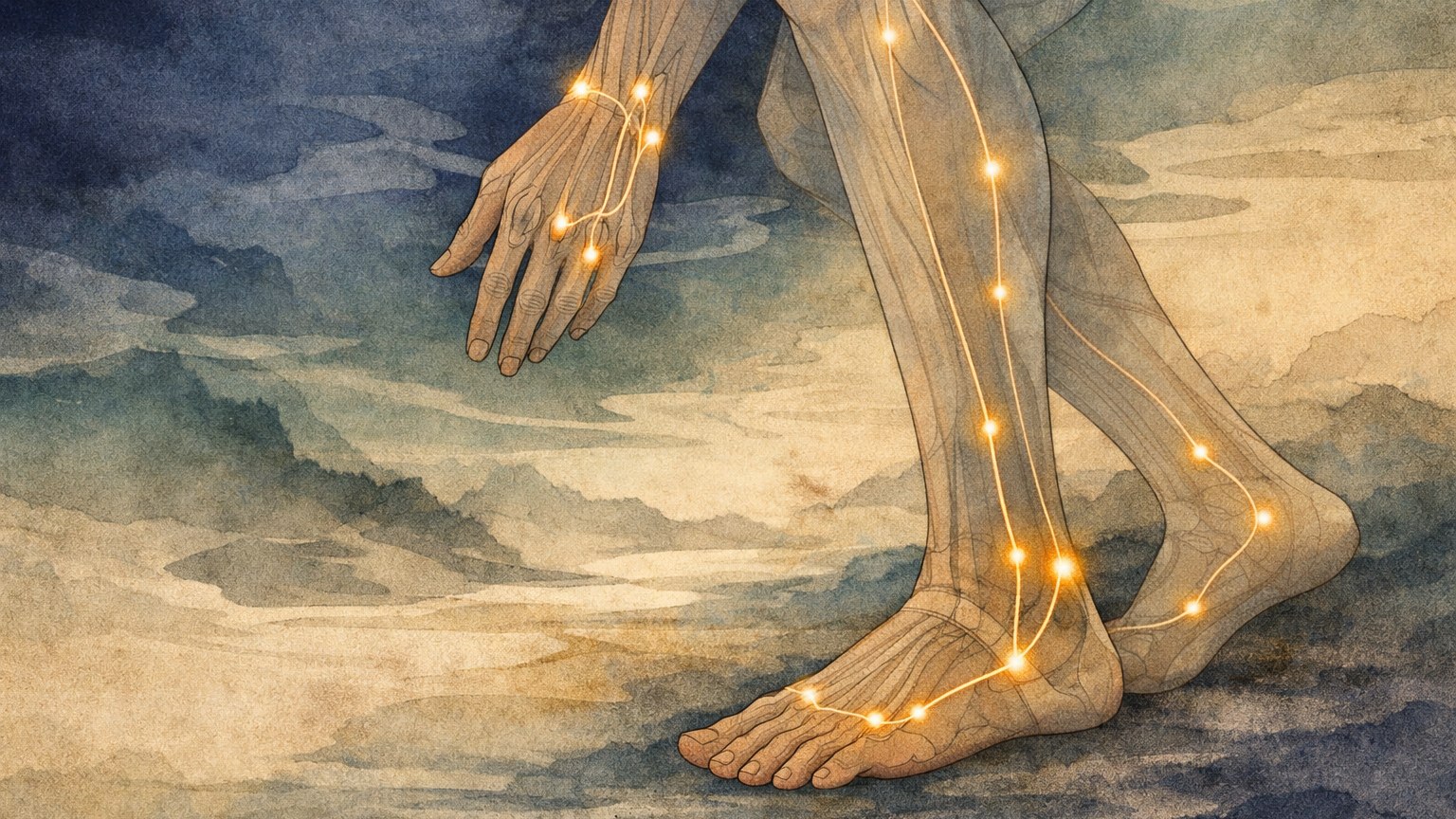
10 Lesser-Known Acupuncture Points: A Map of Crossroads, Reservoirs and Hidden Pathways
Beyond acupuncture’s familiar headline points lies a quieter set of locations that reveal how Traditional Chi…

The Lens That Becomes a Life: How Mental Paradigms Shape What We Notice, Choose and Call “Manifestation”
Our deepest assumptions do not necessarily command the universe, but they can strongly influence perception, …
Apps to use
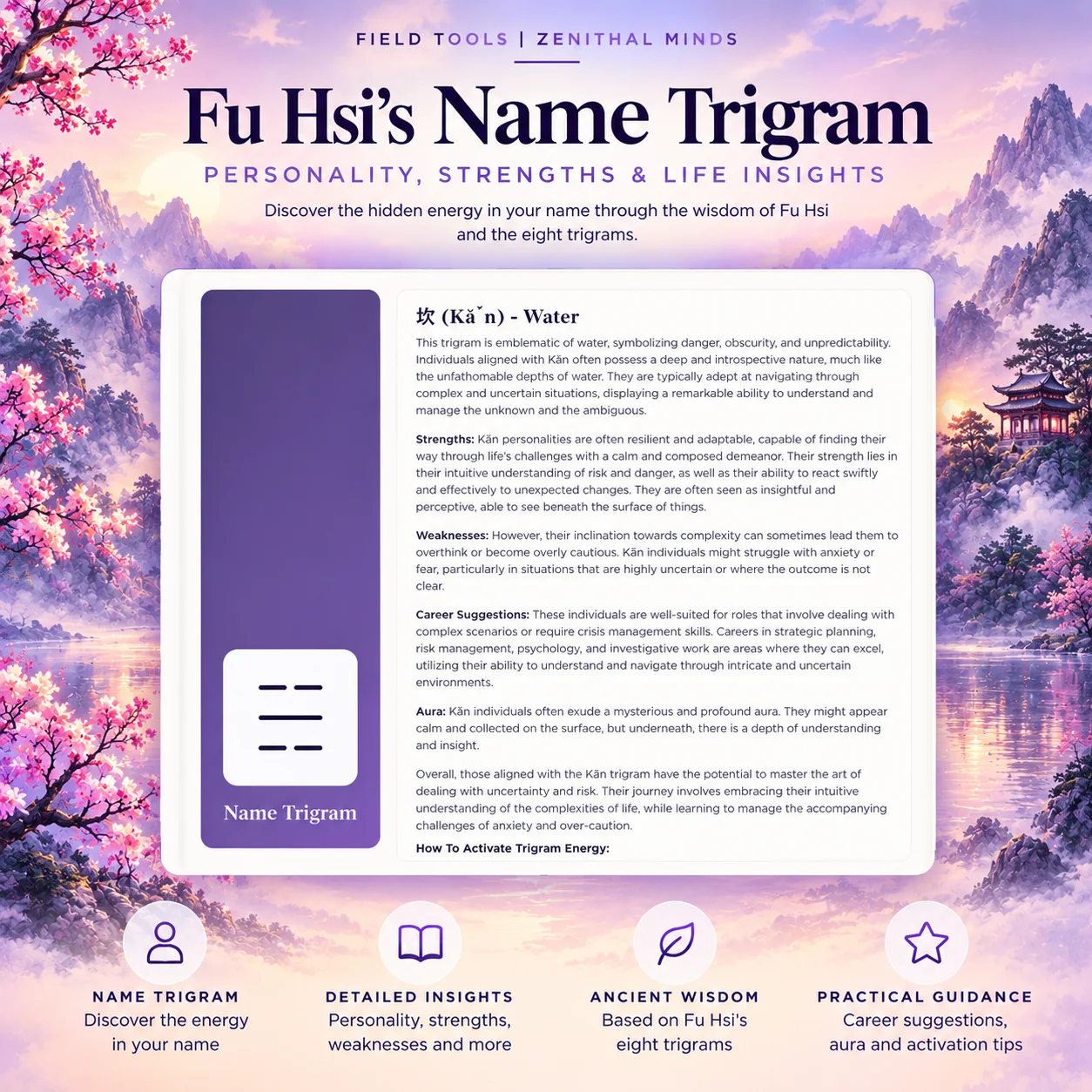
Fu Hsi's Name Trigram
Discover the trigram hidden within your name and explore its personality traits, strengths, weaknesses, caree…
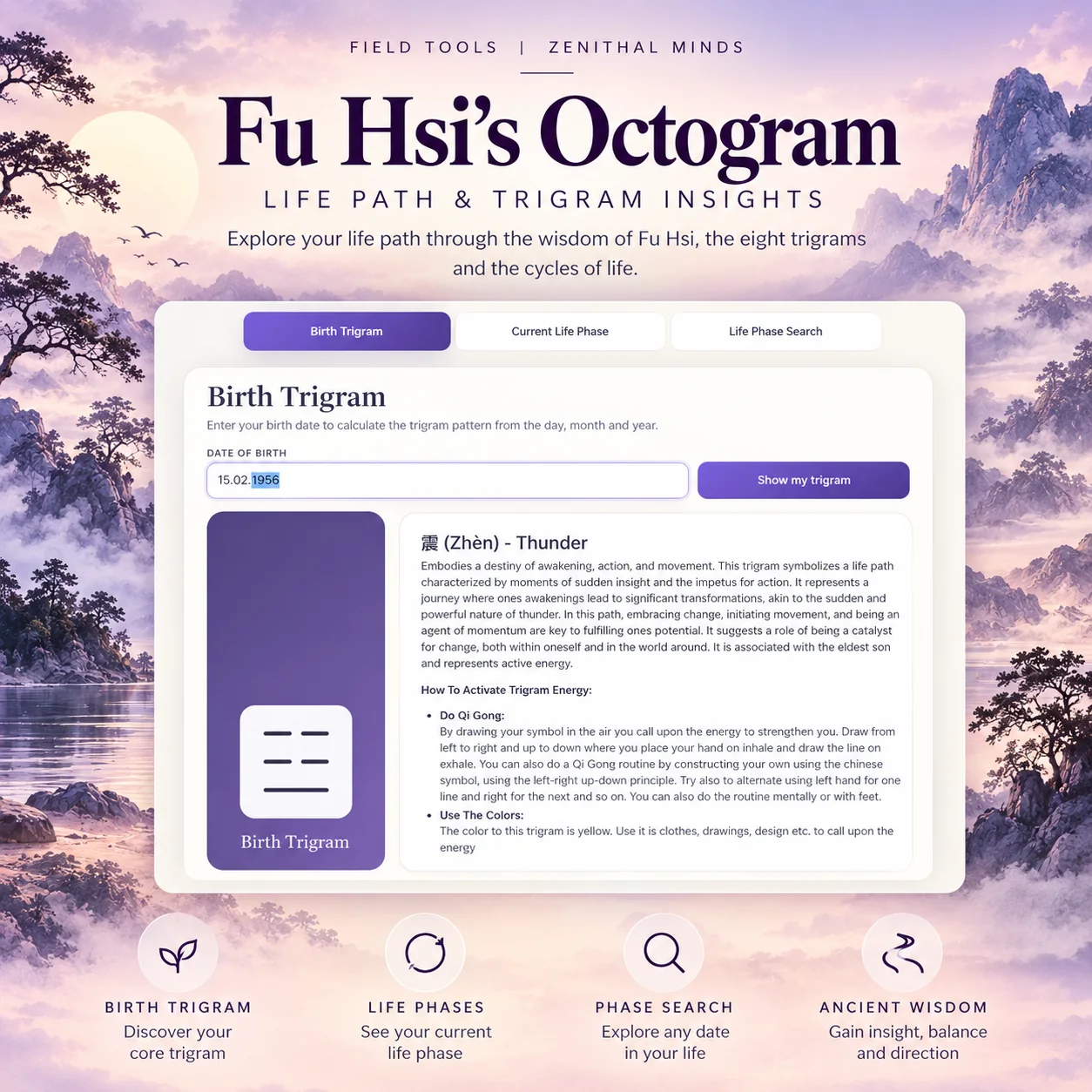
Fu Hsi's Octogram
Discover your birth trigram, explore your current life phase, and search past or future phases through Fu Hsi…

Chinese Zodiac
Discover your Chinese zodiac animal and element from your birth date, and explore its traditional traits, str…