

10 Lesser-Known Acupuncture Points: A Map of Crossroads, Reservoirs and Hidden Pathways
Beyond acupuncture’s familiar headline points lies a quieter set of locations that reveal how Traditional Chinese Medicine imagines circulation: not as a single line of force, but as a system of crossings, reserves, links and extraordinary routes.
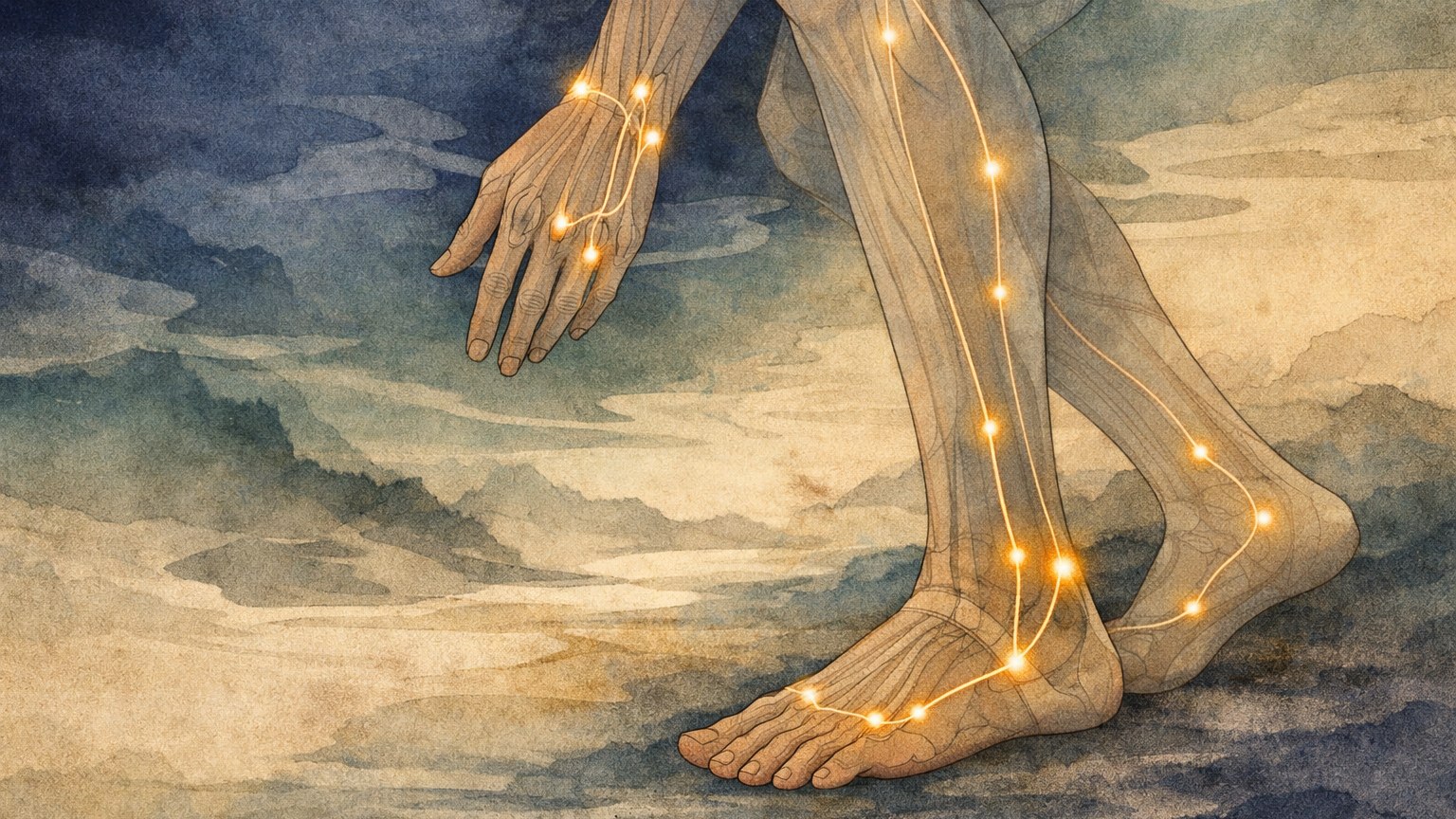
Acupuncture charts can make the body look like a city seen at night: hundreds of named lights, joined by routes that are meaningful within Traditional Chinese Medicine (TCM). Introductory accounts tend to return to a small group of famous points. But some of the system’s most revealing ideas sit elsewhere—in the xi-cleft points where qi and blood are said to gather deeply, the luo-connecting points that link paired channels, and points associated with the eight extraordinary vessels, a set of wider regulatory pathways in TCM theory.
The ten points below are less often featured in beginner articles. Their locations use the WHO’s standardized anatomical descriptions. A cun is a proportional body measurement used in acupuncture, not a fixed imperial inch; locating and needling these points safely requires clinical training. The traditional functions and applications discussed here describe TCM’s own diagnostic language, rather than scientifically demonstrated point-specific outcomes. WHO Standard Acupuncture Point Locations in the Western Pacific Region
The overlooked logic of “special” points
TCM does not treat every point as doing the same kind of work. A xi-cleft point is traditionally understood as a deeper gathering place of channel qi and blood, and is often selected in acute presentations within that channel’s sphere. Luo-connecting points are imagined as branch routes between paired yin and yang channels. The extraordinary vessels, meanwhile, complicate the neat image of twelve separate organ channels: they are traditionally used to think about longer patterns involving constitution, development, posture, cyclical change and the relationship between interior and exterior. These are conceptual structures of Chinese medicine, not anatomical vessels established by modern biomedicine. Introduction to Acupuncture and Moxibustion
1. SP8 (Diji), “Earth Pivot”
Location: On the inner lower leg, posterior to the medial border of the tibia, 3 cun below SP9; it lies near the junction of the upper third and lower two-thirds of the line between the kneecap’s apex and the medial ankle bone. WHO Standard Acupuncture Point Locations in the Western Pacific Region
Traditional place in the system: SP8 is the xi-cleft point of the Spleen channel. In TCM, the Spleen is not simply the anatomical spleen: it is a functional network associated with transformation of food and fluids, containment of blood, and the tendency toward dampness when this transformation is impaired. “Earth Pivot” evokes a hinge rather than a battery—the point where the Earth-phase logic of nourishment, substance and movement is made operational.
Traditional applications: Practitioners have used SP8 particularly in patterns involving acute abdominal pain, menstrual pain or irregular bleeding, alongside fluid-retention and digestive presentations framed as Spleen dysfunction or dampness. Its reputation is distinctive because it joins two TCM themes often treated separately in modern explanations: the handling of fluids and the regulation of blood. Those are traditional indications, not proof that stimulating SP8 treats gynecological or gastrointestinal disease. SP8 · Earth Pivot (Dì Jī)
2. HT6 (Yinxi), “Yin Cleft”
Location: On the palm-side inner forearm, just radial to the flexor carpi ulnaris tendon, 0.5 cun above the wrist crease. It is close to the distal border of the head of the ulna. WHO Standard Acupuncture Point Locations in the Western Pacific Region
Traditional place in the system: HT6 is the Heart channel’s xi-cleft point. “Heart” in TCM includes the governance of blood and the shen, a term that can include consciousness, presence, emotional coherence and the animating clarity of a person. This does not map neatly onto the biomedical heart or a psychiatric diagnosis; it is a different clinical vocabulary.
Traditional applications: Yinxi is traditionally chosen when a practitioner interprets restlessness, disturbed sleep, night sweating, dry mouth or palpitations through a pattern of Heart yin depletion or heat. The point’s logic is not merely “calming”: it is to conserve and cool what is thought to be insufficient, while settling signs of agitation. Such language should not be confused with evidence that HT6 independently treats insomnia, anxiety or cardiac illness. HT-6 – Yinxi
3. SI3 (Houxi), “Back Ravine”
Location: On the ulnar side of the hand, in the depression just proximal to the fifth metacarpophalangeal joint, at the border between red and white skin. With the hand lightly clenched, it is found at the ulnar end of the distal palmar crease. WHO Standard Acupuncture Point Locations in the Western Pacific Region
Traditional place in the system: SI3 is a Shu-stream point of the Small Intestine channel and a confluent point of the Governing Vessel (Du Mai). The Du Mai runs along the midline of the back in the traditional map and is often described as coordinating yang aspects of the body. SI3 therefore illustrates a recurring acupuncture idea: a small hand point may be selected not because it lies near a symptom, but because of a channel relationship.
Traditional applications: In TCM practice, SI3 may appear in prescriptions for neck and upper-back stiffness, occipital headache, spinal discomfort, or patterns described as wind or heat affecting the channel. Its interest lies in the back-ravine image: a distal point imagined as offering access to a longitudinal axis. That is a traditional network relationship, not a validated biomedical pathway from the hand to the spine. Non-Duality and the Second Ancestry
4. BL58 (Feiyang), “Soaring Upward”
Location: On the posterolateral calf, between the lower border of the lateral head of gastrocnemius and the Achilles tendon, level with 7 cun above BL60. It is about 1 cun lateral and distal to BL57. WHO Standard Acupuncture Point Locations in the Western Pacific Region
Traditional place in the system: BL58 is the luo-connecting point of the Bladder channel, whose collateral is traditionally said to connect with the Kidney channel. In TCM, the Bladder–Kidney pairing is much broader than urinary anatomy: it is a yin–yang partnership used to reason about fluids, the low back, fear, will and constitutional reserve.
Traditional applications: Feiyang is traditionally associated with pain and tightness along the posterior leg and back, while older point literature also links it with head and nasal symptoms. The name “Soaring Upward” hints at its unusual reach: a point on the calf can be considered in a pattern that rises to the head because the channel map is a map of relationships, not a local-muscle referral chart. The Study of Acupuncture: Sources and Study Techniques #3
5. BL63 (Jinmen), “Golden Gate”
Location: On the upper outer foot, just in front of the lateral ankle bone and behind the tuberosity of the fifth metatarsal, in a depression below the cuboid bone. WHO Standard Acupuncture Point Locations in the Western Pacific Region
Traditional place in the system: BL63 is the xi-cleft point of the Bladder channel. Xi-cleft points are traditionally treated as places where the channel’s movement has depth and urgency. “Golden Gate” is a suggestive name for a point at the lateral edge of the foot, where the Taiyang channel begins its ascent through the back.
Traditional applications: Traditional indications include acute lumbar pain, outer-ankle pain, urinary difficulty, and convulsive or seizure-like presentations in classical terminology. Those old categories do not translate directly into modern diagnoses, and they should never be used as a reason to self-treat neurological symptoms instead of seeking medical care. The enduring conceptual point is that TCM gives a channel’s xi-cleft point a role in sudden, intense or sharply localized disturbances. Jinmen BL-63
6. KI9 (Zhubin), “Guest House”
Location: On the posteromedial lower leg, between the soleus muscle and Achilles tendon, 5 cun above the medial ankle bone. It is level with LR5. WHO Standard Acupuncture Point Locations in the Western Pacific Region
Traditional place in the system: KI9 is the xi-cleft point of the Yin Linking Vessel (Yin Wei Mai). The Yin Wei is traditionally described as binding and coordinating the yin channels, with associations that draw the chest, abdomen and inner life into one pattern. This is one reason extraordinary-vessel theory can feel philosophically different from an organ-by-organ approach: it asks how a person is held together across regions and time.
Traditional applications: Zhubin is traditionally used in presentations involving lower-leg pain, urinary or genital patterns, and emotional disturbance interpreted through Kidney deficiency, phlegm, heat or constrained qi. Some lineages emphasize its use for fright, agitation or oppression in the chest. These descriptions express a particular TCM pattern language; no robust scientific evidence establishes KI9 as a specific treatment for depression, anxiety or any named disease. Non-Duality and the Second Ancestry
7. TE5 (Waiguan), “Outer Pass”
Location: On the back of the forearm, midway between the radius and ulna, 2 cun above the dorsal wrist crease. Its palm-side counterpart is PC6. WHO Standard Acupuncture Point Locations in the Western Pacific Region
Traditional place in the system: TE5 is the luo-connecting point of the Triple Energizer channel and a confluent point of the Yang Linking Vessel (Yang Wei Mai). Triple Energizer is not an anatomical organ. It is a TCM functional framework for distribution and communication across the upper, middle and lower body. The Yang Wei, meanwhile, links yang channels and is traditionally relevant to the body’s exterior-facing, mobile and defensive aspects.
Traditional applications: Waiguan is often selected traditionally for lateral headache, neck and shoulder tension, ear symptoms, feverish exterior patterns, and pain along the channel. Its “outer pass” name is apt: the point is commonly understood as helping to regulate the boundary between exterior influence—often termed wind in TCM—and the body’s response. That is a classical explanatory model, not confirmation that a needle at TE5 changes immunity or treats infections. Non-Duality and the Second Ancestry
8. GB35 (Yangjiao), “Yang Intersection”
Location: On the outer lower leg, behind the fibula, 7 cun above the lateral ankle bone; it lies 1 cun below the midpoint between that ankle landmark and the outer end of the knee crease. WHO Standard Acupuncture Point Locations in the Western Pacific Region
Traditional place in the system: GB35 is the xi-cleft point of the Yang Linking Vessel. This makes it an intriguing companion to TE5: TE5 is commonly used as the vessel’s confluent point, while GB35 is where its qi is traditionally said to collect. The pair makes visible an idea that introductory lists often flatten—the same vessel can have different kinds of points, each with a different strategic role.
Traditional applications: Traditional practice associates GB35 with disorders along the lateral leg and with patterns involving the Gallbladder channel or Yang Wei network, including pain, tension and certain acute exterior presentations. The Gallbladder in TCM also carries symbolic associations with decisiveness and the capacity to act. That symbolic layer can be clinically meaningful within the tradition without being evidence that GB35 physiologically improves decision-making. Introduction to Acupuncture and Moxibustion
9. GB41 (Zulinqi), “Foot Overlooking Tears”
Location: On the top of the foot, just beyond the junction of the fourth and fifth metatarsal bases, in the depression lateral to the fifth extensor digitorum longus tendon. WHO Standard Acupuncture Point Locations in the Western Pacific Region
Traditional place in the system: GB41 is the Gallbladder channel’s Shu-stream point and the confluent point of the Belt Vessel (Dai Mai). The Dai Mai is traditionally imagined as encircling the waist, unlike the more vertical channels. Its image is that of a belt: it binds, contains and organizes what might otherwise spill or descend.
Traditional applications: Practitioners traditionally use GB41 for lateral head pain, eye and ear symptoms, rib-side discomfort, breast patterns, and gynecological complaints understood through the Dai Mai or Gallbladder channel. The deeper philosophical usefulness of the point is its geometry. Rather than asking only whether qi rises or falls, it asks whether a system has enough containment. That is a diagnostic metaphor within Chinese medicine—not evidence for a literal energetic belt around the torso. Non-Duality and the Second Ancestry
10. LR5 (Ligou), “Woodworm Canal”
Location: On the inner lower leg, at the center of the medial surface of the tibia, 5 cun above the medial ankle bone. It is at the same level as KI9. WHO Standard Acupuncture Point Locations in the Western Pacific Region
Traditional place in the system: LR5 is the luo-connecting point of the Liver channel, traditionally linking toward the Gallbladder channel. In TCM, the Liver system is associated with the free coursing of qi, menstrual cycles, sinews and the tendency for constraint to appear as pain, irritability, fullness or a sense of obstruction. The unusual name, “Woodworm Canal,” suggests an irregular burrowing course rather than a smooth, straight flow.
Traditional applications: LR5 has classical associations with genital itching, hernia-like lower-abdominal pain, urinary presentations, irregular menstruation and uterine prolapse. Some traditions also include emotionally charged patterns, especially when distress is expressed as a sensation of blockage in the throat or chest. The point is therefore a useful corrective to the simplistic claim that TCM emotions are “all in the mind”: its language treats feeling, movement, sexuality, digestion and posture as mutually expressive dimensions of one pattern. The Study of Acupuncture: Sources and Study Techniques #3
What these points reveal—and what they do not prove
Taken together, these ten points suggest that acupuncture is not merely a catalogue of symptom buttons. It is a grammar of movement: SP8 as a pivot of blood and dampness; HT6 as a cleft where depletion and agitation meet; SI3 as a distal access point to the back’s central axis; TE5 and GB41 as routes into linking and encircling vessels. Whether one accepts TCM’s metaphysics or not, its diagnostic imagination is strikingly systemic. It asks not only “Where does it hurt?” but “What is connecting, accumulating, escaping, binding or failing to circulate?”
Modern research does not establish that these named points possess the distinct, disease-specific effects attributed to them in traditional texts. Reviews have found that the scientific basis of acupoint specificity remains unresolved, and evidence about acupuncture overall varies considerably by condition and comparison method. There is evidence that acupuncture may help some pain conditions, but that cannot validate every traditional indication for every point. Needle treatments should be performed with sterile single-use needles by appropriately licensed practitioners, and serious, sudden or neurological symptoms warrant conventional medical assessment. Acupuncture: Effectiveness and Safety Acupoint Sensitivity in Health and Disease: A Systematic Review
Sources and references
More to read

The Afterlife of the Unlived: Do Forgotten Possibilities Still Exist?
An unrealized future can vanish from memory, paper and testimony. But does that erase it completely—or does i…
10 Lesser-Known Acupuncture Points: A Map of Pathways, Thresholds and Traditional Use
Beyond the famous hand and leg points lies a quieter acupuncture map: ten classical sites whose locations, po…

The Inner Pass and the Outer Pass: PC6, SJ5, and the Art of Emotional Sovereignty
PC6 Neiguan and SJ5 Waiguan sit on opposite sides of the forearm like two doors in one wall. Read philosophic…
Apps to use
Fu Hsi's Name Trigram
Discover the trigram hidden within your name and explore its personality traits, strengths, weaknesses, caree…
Fu Hsi's Octogram
Discover your birth trigram, explore your current life phase, and search past or future phases through Fu Hsi…
Chinese Zodiac
Discover your Chinese zodiac animal and element from your birth date, and explore its traditional traits, str…