The Library That Must Never Be Opened
At Herculaneum, some of the most precious books from the ancient world survive as blackened, tightly wound cylinders. A new generation of scans, geometry and machine learning is making them readable without ever touching the first layer.
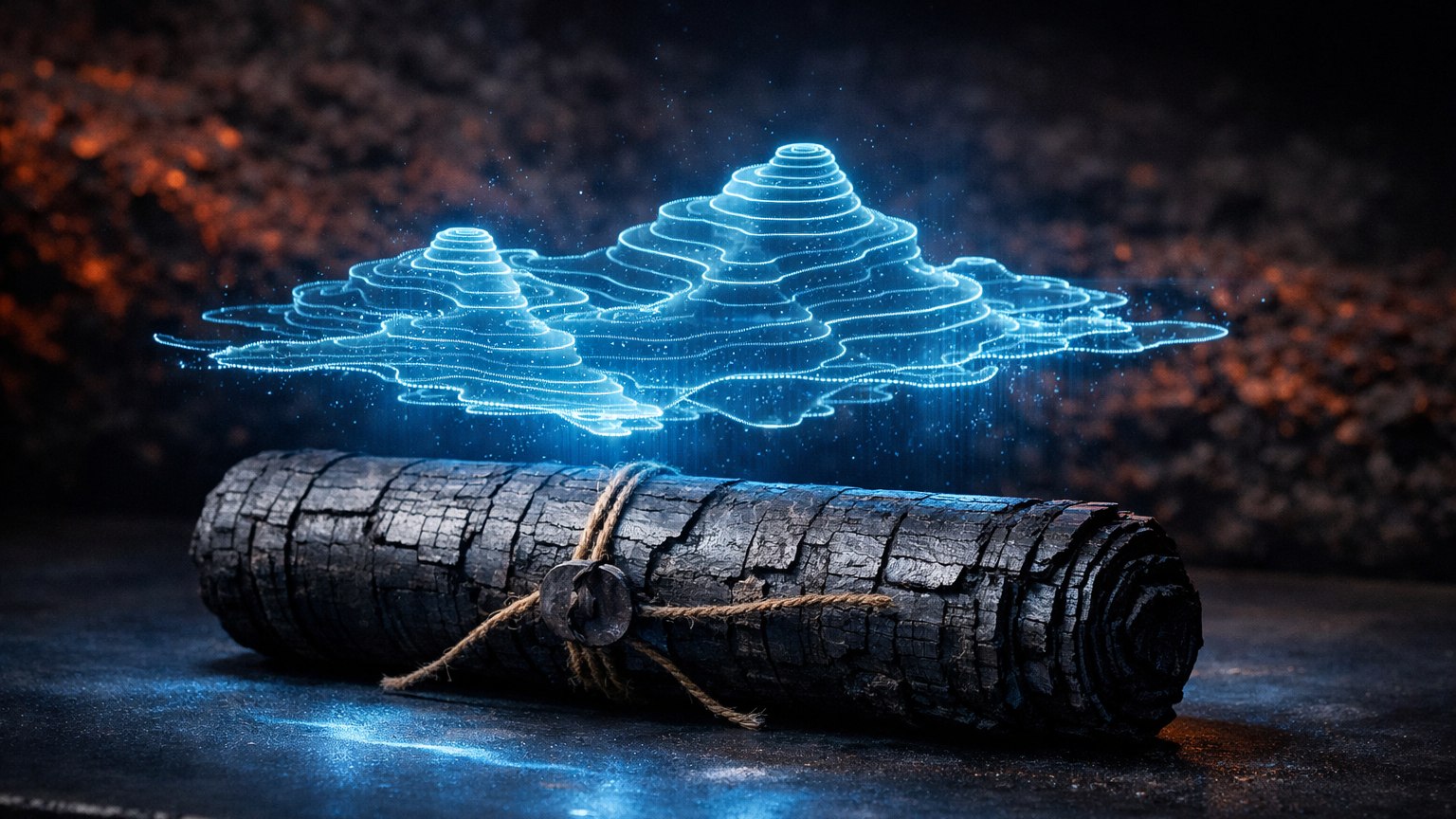
Imagine owning a book so fragile that opening it would destroy it—and then discovering that, for nearly two millennia, its unread pages may have survived inside. That is the peculiar promise of the Herculaneum papyri: carbonized scrolls buried in the eruption of Vesuvius in 79 CE, preserved not as readable books but as warped, coal-black objects. The exciting development is not simply that artificial intelligence has “decoded” an ancient text. It is that scholars are learning to treat a sealed object as a readable landscape: one that can be surveyed, flattened and interpreted without being physically opened. The National Endowment for the Humanities describes the cache as the only large-scale library from classical antiquity to survive in its entirety.
The paradox of preservation
The Villa of the Papyri at Herculaneum offered an unusually cruel bargain. Volcanic heat and ash destroyed a Roman town but also carbonized many papyrus rolls rather than allowing them simply to rot. When the scrolls were found in the eighteenth century, attempts to unroll them often damaged or obliterated their contents. The surviving objects therefore embody a contradiction: their texts endured because they became nearly impossible to read. The Vesuvius Challenge, an open-science project devoted to the scrolls, notes that the library was buried under roughly 20 metres of ash and that the rolls were preserved by heat in carbonized form.
That contradiction matters because a scroll is not merely a container with writing hidden inside it. Its sheets have been compressed, cracked and distorted into a dense three-dimensional puzzle. In a conventional book, the reader turns pages. Here, the pages no longer present themselves as pages at all. They are nested surfaces that must first be located within a scan, traced through damage, and transformed into a two-dimensional field before a papyrologist can begin the slower work of identifying letters, reconstructing words and interpreting a text.
Not an AI oracle, but a new instrument of reading
The phrase “AI reads ancient scroll” makes a neat headline, but it blurs several distinct tasks. High-resolution X-ray computed tomography creates a three-dimensional record of the object. Researchers then reconstruct the geometry of individual papyrus layers and digitally flatten them—a process known as virtual unwrapping. Machine-learning systems can enhance extremely subtle signals associated with ink or surface texture. Human specialists still assess whether marks really form letters, transcribe damaged Greek, register uncertainty and make historical sense of the result.
This division of labor is more than a technical footnote. In a June 27, 2026 preprint, the team behind the project stressed that its ink-recovery models were not trained on character identities, words or translations; they functioned as visibility aids for expert inspection. The authors reported the first complete digital unwrapping and extended scholarly reading of a still-rolled Herculaneum papyrus, PHerc. 1667, while also identifying another sealed roll, PHerc. 139, as Philodemus’ On Gods, Book 8. Because the paper is a preprint, its broader claims should be treated as research findings awaiting the normal scrutiny of formal peer review—not as a final closing of the case. Complete virtual unwrapping and reading of a rolled Herculaneum papyrus
Still, the conceptual achievement is already striking. The goal is not to ask a language model to invent what an ancient author might have said. It is to make physical traces available for inspection where the human eye cannot reach them. In that sense, the technology is closer to a microscope, medical imaging system and cartographic projection combined. It does not replace philology—the study of texts, languages and manuscripts. It gives philology a new kind of evidence.
Why carbon is such a stubborn enemy
Reading the Herculaneum scrolls is especially difficult because both the writing surface and much of the ink are carbon-based. An X-ray scan often cannot separate one cleanly from the other by simple contrast. The challenge is therefore not just to find a rolled sheet but to detect tiny differences in relief, density, texture or deposits associated with strokes. The 2026 preprint reports that, under optimized scanning conditions, some ink-bearing deposits in one scroll could be directly segmented in three dimensions, providing an independent check on the rendered ink signal. The project’s technical report
That detail points to an important standard for the field: a legible-looking image is not enough. Archaeology has a long history of wishful readings, especially when objects are fragmentary and expectations are high. A convincing recovery needs a traceable route from physical object to scan, from scan to mapped surface, from surface to visible marks, and from marks to a cautious transcription. The best version of this work makes its uncertainty visible rather than smoothing it away.
A library is more than its most dramatic sentence
The first widely publicized passages from a sealed scroll concerned pleasure and were attributed to the Epicurean philosopher Philodemus of Gadara. They mattered partly because they demonstrated that continuous text could be recovered at all. Yet the deeper prize is not necessarily a lost masterpiece or a sensational revelation. A title, a book number, a marginal note, a scribal habit or an apparently minor philosophical dispute can change how scholars understand what a library contained, how texts circulated, and which arguments ancient readers considered worth copying. NEH’s account of the 2024 breakthrough notes that more than 2,000 characters were recovered from early passages, interpreted as a discussion of pleasure and likely connected to Philodemus.
The identification of On Gods, Book 8, offers a good example of why metadata can be intellectually dramatic. A title can establish that a work extended farther than previously known; a book number can reveal the scale of an author’s project. This is the archaeology of intellectual infrastructure. Instead of recovering only isolated quotations, researchers may eventually recover evidence of catalogues, sequences, genres and rival schools of thought—the shape of a reading world.
The strange possibility: archaeology without extraction
There is a philosophical shift hiding in this technical story. Traditional excavation often means removal: bring the object out, separate it from its context, open it, clean it, stabilize it and display it. Virtual unwrapping suggests another ideal. What if the most responsible way to discover an artifact’s contents is to leave its body intact?
This does not make physical archaeology obsolete. Scans require expertise, costly instruments, careful handling and prior archaeological knowledge. Nor does a digital rendering become identical to the ancient object; it is an interpretation shaped by imaging choices, algorithms and scholarly judgment. But the method changes the ethics of access. Knowledge no longer always demands that a vulnerable object pay for revelation with its material integrity.
The Herculaneum library consequently offers a useful correction to the familiar story that digital tools make the past frictionless. Here, digitization does not make an ancient text instantly searchable or magically certain. It makes patience possible at a new scale. Each recovered line depends on physicists, conservators, engineers, software developers and papyrologists agreeing that a faint mark deserves to be seen before it is made to speak.
The scrolls may yet yield works that alter the history of philosophy. They may also yield repetitions, drafts, arguments we find tedious, and authors already known. Either outcome would be valuable. A library is not important only when it produces a miracle; it is important because it preserves the ordinary density of a vanished intellectual world. Herculaneum’s greatest discovery may be that an unopened book is not necessarily a silent one.
Sources and references
More to read
The Accidental Museum in Your Air Filter
A used HVAC or air-purifier filter is not merely grimy refuse. It is a biased, time-blurred sample of particl…

Earth’s Oldest Witnesses Are Not Rocks, but Grains of Sand
Tiny zircon crystals have outlived the landscapes that formed them. Their chemical archives offer a startling…

After the Bleaching Map Turns Purple: Who Decides What Reef Recovery Looks Like?
When a satellite heat-stress map reaches its darkest colors, the emergency is only beginning. In the Florida …
Apps to use
Hexamgram of Time
Generate a six-line hexagram from the current time or any two numbers and explore the symbolic meaning of its…

Video Forge
Upload one or more images, add your soundtrack, and bring everything to life with customizable motion and vis…
Noise Sculptor
Shape your perfect noise. Mix 10 frequency bands, explore noise presets, adjust stereo width, and download yo…