

10 Lesser-Known Acupuncture Points: A Map of Pathways, Thresholds and Traditional Use
Beyond the famous hand and leg points lies a quieter acupuncture map: ten classical sites whose locations, point categories and traditional roles reveal how Chinese medicine thinks about circulation, connection and change.
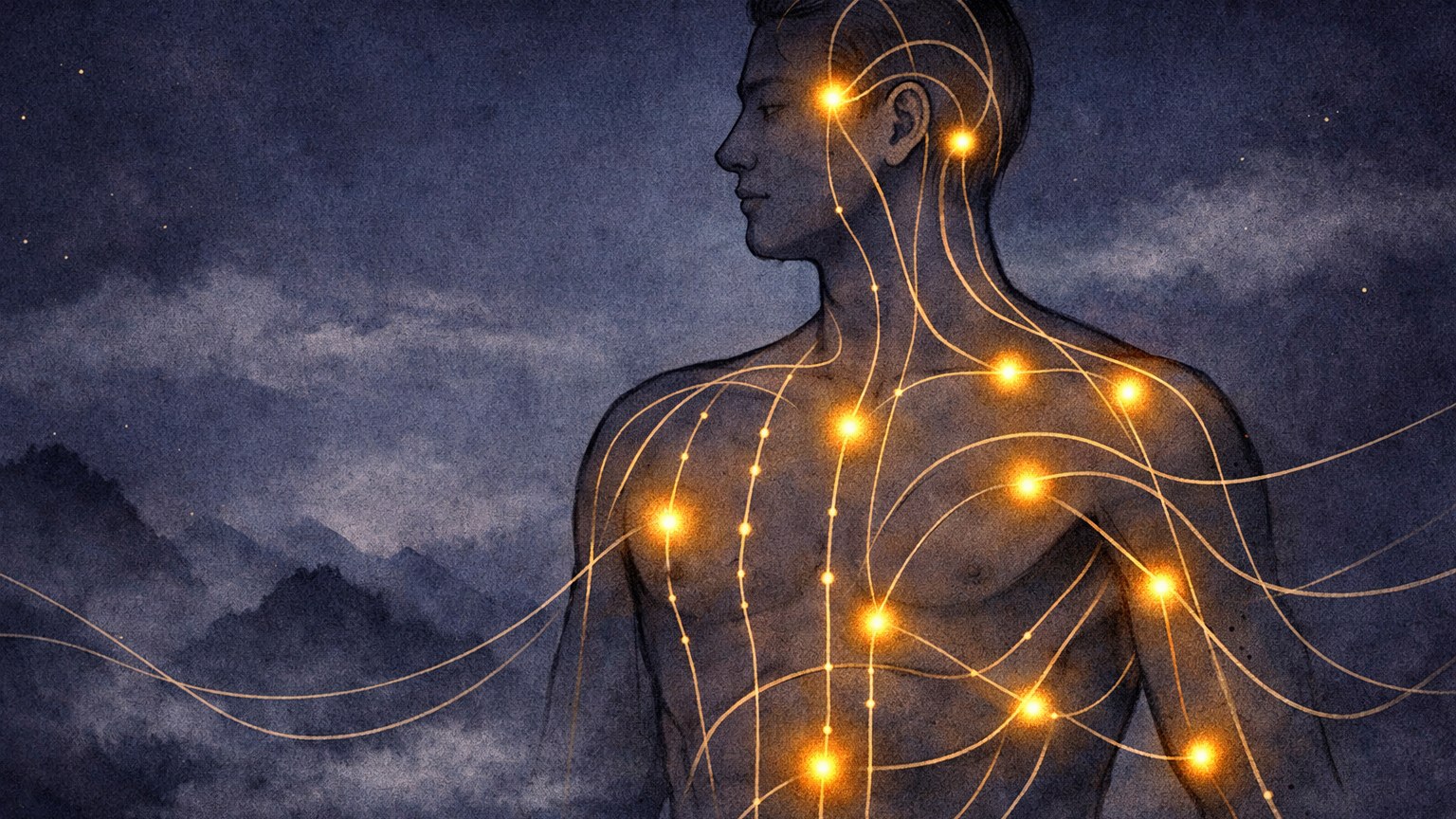
Acupuncture charts can make the body look like a transit map: lines traverse the limbs and torso, while named stations mark where a practitioner might intervene. The familiar stops—LI4, ST36 and PC6—are useful entry points, but they can obscure the system’s stranger and more revealing terrain. This guide follows ten less frequently discussed classical points, chosen not as a self-treatment menu but as windows into Traditional Chinese Medicine (TCM): its ideas of qi, blood, fluids, the spirit (shen), and the channels that connect surface, interior and movement.
Locations below use the international acupuncture-point standard. A cun is a proportional body measurement rather than a universal inch; practitioners locate points through anatomical landmarks, palpation and individual proportions. The traditional functions described here are concepts within TCM, not scientifically established effects of stimulating any specific point. Acupuncture should be performed by a properly trained, licensed professional; incorrect needling can cause injury and infection. WHO Standard Acupuncture Point Locations in the Western Pacific Region Acupuncture: Effectiveness and Safety
The useful strangeness of a point map
TCM does not treat a point as a tiny button that mechanically “fixes” one symptom. A point’s traditional significance depends on its place in a channel, its category and the pattern a practitioner believes is present. A luo-connecting point, for example, is said to create a collateral connection between paired channels; a xi-cleft point is traditionally associated with acute accumulations along a channel. Whether one accepts those premises literally or reads them as an old clinical language, the categories show a distinctive philosophy: health is not merely a matter of parts functioning separately, but of relationships remaining passable.
1. SP8 Diji — Earth Pivot
Location: On the medial lower leg, immediately posterior to the medial border of the tibia, 3 cun below SP9, at the junction of the upper third and lower two-thirds of the line between the patella and medial malleolus.
Traditional role: SP8 is the xi-cleft point of the Spleen channel. In TCM, the Spleen’s sphere includes transformation of food and fluids and the containment of blood. Diji is therefore traditionally selected in patterns involving acute lower-abdominal pain, menstrual pain or irregular uterine bleeding, especially where a practitioner interprets the problem through blood and dampness rather than through a single biomedical diagnosis. Its name, “Earth Pivot,” evokes a hinge: the point is imagined as a place where heaviness, fluid and cyclical change can be brought back into orderly movement. WHO Standard Acupuncture Point Locations in the Western Pacific Region SP-8 Dìjī (地机) — Earth Pivot
2. KI8 Jiaoxin — Intersection Reach
Location: On the medial lower leg, posterior to the medial border of the tibia, 2 cun above the prominence of the medial malleolus and 0.5 cun anterior to KI7.
Traditional role: KI8 is the xi-cleft point of the Yin Qiao vessel, one of the eight extraordinary vessels. These vessels are often understood as deeper reservoirs or regulators rather than simply another set of primary channels. The Yin Qiao vessel is traditionally linked with the inward, resting and lower-body dimensions of yin. Jiaoxin is consequently used in classical teaching for menstrual irregularity, abnormal uterine bleeding, lower-abdominal discomfort and some genital or urinary patterns. The “intersection” in its name matters: this is a point where TCM imagines ordinary channel traffic touching a more foundational current of rhythm, reproduction and rest. WHO Standard Acupuncture Point Locations in the Western Pacific Region KI-8 Jiāoxìn (交信) — Intersection Reach
3. LR5 Ligou — Woodworm Canal
Location: On the medial side of the lower leg, posterior to the medial border of the tibia, 5 cun above the prominence of the medial malleolus.
Traditional role: LR5 is the luo-connecting point of the Liver channel. In TCM, “Liver” is a functional network associated with the smooth coursing of qi, the storage of blood and the tendency for constraint to appear as tension, irritability, irregular cycles or pain. Ligou is traditionally discussed for genital itching, damp-heat patterns in the lower burner, and certain menstrual or urinary complaints. It is a reminder that a channel’s route is not merely anatomical: the Liver channel’s course through the inner leg and groin gives older practitioners a way to connect local symptoms with a wider story of flow, blood and constraint. WHO Standard Acupuncture Point Locations in the Western Pacific Region Atlas of Acupuncturology
4. HT5 Tongli — Penetrating the Interior
Location: On the anteromedial forearm, on the radial side of the flexor carpi ulnaris tendon, 1 cun above the palmar wrist crease.
Traditional role: HT5 is the Luo-connecting point of the Heart channel. The Heart in TCM includes circulation but also houses shen, the animating and cognitive-spiritual aspect of a person. Tongli is traditionally associated with palpitations, restlessness, speech difficulty, tongue stiffness and sudden hoarseness. Its enduring conceptual interest lies in the connection TCM draws between inward coherence and expression: a disturbed “Heart network” may be said to show itself not only in feeling, but in voice and tongue. That is a traditional interpretive framework, not evidence that HT5 specifically treats neurological or cardiac disease. WHO Standard Acupuncture Point Locations in the Western Pacific Region HT-5 Tōnglǐ Acupuncture Point — Penetrating the Interior
5. SI7 Zhizheng — Branch of the Upright
Location: On the posteromedial forearm, between the medial border of the ulna and flexor carpi ulnaris, 5 cun above the dorsal wrist crease.
Traditional role: SI7 is the Luo-connecting point of the Small Intestine channel. TCM gives the Small Intestine an unusual job: separating the clear from the turbid—both in digestion and, by extension, in discernment. Zhizheng is traditionally used for neck and elbow problems along the channel, but also for febrile presentations and agitation. The philosophical claim is not that an elbow point literally performs moral judgment. Rather, TCM repeatedly uses bodily separation as a model for mental clarity: what should be retained, what should be transformed, and what should be released? WHO Standard Acupuncture Point Locations in the Western Pacific Region SI-7 Zhīzhèng Acupuncture Point — Branch of the Upright
6. BL58 Feiyang — Soaring Upward
Location: On the posterolateral lower leg, at the posterior border of the fibula, 7 cun above BL60 and about 1 cun inferior and lateral to BL57.
Traditional role: BL58 is the Luo-connecting point of the Bladder channel, which TCM pairs with the Kidney channel. Traditional references connect it with headache, neck and back pain, leg weakness, nasal obstruction and hemorrhoids. At first that list can seem arbitrary. Within channel theory, however, the Bladder pathway runs from the head down the back and leg, while its Luo connection is said to communicate with the Kidney network. Feiyang makes visible an old clinical intuition: symptoms at distant poles of the body may be read as part of one longitudinal pattern rather than isolated local failures. WHO Standard Acupuncture Point Locations in the Western Pacific Region Feiyang (BL 58)
7. GB37 Guangming — Bright Light
Location: On the lateral leg, 5 cun above the prominence of the lateral malleolus, on the anterior border of the fibula.
Traditional role: GB37 is the Luo-connecting point of the Gallbladder channel and is classically associated with blurred vision, eye pain and night blindness, as well as lateral leg and breast symptoms. Its name—“Bright Light”—is not merely poetic decoration. In TCM, the Gallbladder and Liver networks are closely related, and the Liver is traditionally said to “open into the eyes.” GB37 therefore belongs to a web of traditional correspondences between decisiveness, the Wood phase, sinews and vision. This does not establish that needling GB37 improves eye disease; visual changes deserve appropriate medical assessment. WHO Standard Acupuncture Point Locations in the Western Pacific Region GB-37 Guangming (光明) — Location, Indications, and Technique
8. TE3 Zhongzhu — Central Islet
Location: On the dorsum of the hand, in the depression between the fourth and fifth metacarpal bones, just proximal to the fourth metacarpophalangeal joint.
Traditional role: TE3 is the Shu-stream point of the Triple Energizer, also translated as San Jiao. The Triple Energizer is not a discrete anatomical organ; it is a TCM framework for the body’s upper, middle and lower functional spaces and for the movement of qi and fluids between them. Zhongzhu is traditionally used for temporal headache, ear symptoms, shoulder or neck pain and stiffness of the ring and little fingers. Here the key idea is distribution: not simply making more qi, but allowing communication among regions that have become obstructed or poorly coordinated. WHO Standard Acupuncture Point Locations in the Western Pacific Region Atlas of Acupuncturology
9. BL43 Gaohuangshu — Vital Region Shu
Location: On the upper back, at the level of the lower border of the fourth thoracic spinous process, 3 cun lateral to the posterior midline. Its location sits beneath the scapular region and requires skilled anatomical assessment.
Traditional role: BL43 is an outer Bladder-channel point traditionally used for deep deficiency patterns, including chronic cough, fatigue, night sweating and constitutional weakness. “Gaohuang” refers to a profound, difficult-to-reach vital region in classical Chinese thought. That history gives the point a distinctive status: it symbolizes conditions imagined as having sunk beneath superficial treatment. The useful modern lesson is not that illness has a mystical hiding place, but that TCM differentiates between temporary disturbance and long-standing depletion—and tries to treat those narratives differently. WHO Standard Acupuncture Point Locations in the Western Pacific Region Atlas of Acupuncturology
10. CV15 Jiuwei — Turtledove Tail
Location: On the anterior midline of the upper abdomen, 7 cun above the center of the umbilicus and 1 cun below the xiphisternal junction.
Traditional role: CV15 is the Luo-connecting point of the Conception Vessel, the extraordinary vessel that runs along the front midline. Classical texts associate it with chest and epigastric fullness, reflux-like symptoms, agitation and disorders of the shen. Its location, below the sternum and above the abdomen, makes it an evocative threshold point: a place where breath, appetite, emotion and posture all meet in ordinary experience. In TCM terms, it is used to descend rebellious qi and settle the spirit. In practical terms, a point in this sensitive region should never be treated casually or by untrained self-needling. WHO Standard Acupuncture Point Locations in the Western Pacific Region Atlas of Acupuncturology
What these ten points reveal
The surprising feature of this map is that its logic is less like a set of isolated remedies than a theory of thresholds. SP8 addresses cyclical accumulation; KI8 links a primary channel to an extraordinary vessel; Luo points such as LR5, HT5, SI7, BL58, GB37 and CV15 are conceived as relational bridges; TE3 imagines distribution across functional spaces; BL43 turns toward depth and constitution. Taken seriously on its own terms, TCM asks a provocative question: what if a symptom is not only a problem located somewhere, but evidence of a relationship that has become difficult to sustain?
That is a philosophical and clinical language, not a demonstrated map of hidden anatomy. Modern evidence suggests acupuncture may help some pain conditions, but mechanisms remain incompletely understood, results vary by condition and study design, and research does not validate every traditional point-specific claim. The most responsible way to approach these ten sites is therefore as part of a living medical tradition—one that can inform conversation with a qualified practitioner, while not replacing evaluation and treatment for serious, persistent or new symptoms. Acupuncture: Effectiveness and Safety
Sources and references
- WHO Standard Acupuncture Point Locations in the Western Pacific Region
- Atlas of Acupuncturology
- Acupuncture: Effectiveness and Safety
- SP-8 Dìjī (地机) — Earth Pivot
- KI-8 Jiāoxìn (交信) — Intersection Reach
- HT-5 Tōnglǐ Acupuncture Point — Penetrating the Interior
- SI-7 Zhīzhèng Acupuncture Point — Branch of the Upright
- Feiyang (BL 58)
More to read
10 Lesser-Known Acupuncture Points: A Map of Crossroads, Reservoirs and Hidden Pathways
Beyond acupuncture’s familiar headline points lies a quieter set of locations that reveal how Traditional Chi…
Can Touch Be a Form of Knowledge?
A hand on the chest or neck may not diagnose what is wrong. But it can change what becomes perceptible—and th…

Can Touch Be a Form of Knowledge?
A hand on the neck, stomach, or chest can change more than discomfort. It can make sensation legible—without …
Apps to use
Fu Hsi's Name Trigram
Discover the trigram hidden within your name and explore its personality traits, strengths, weaknesses, caree…
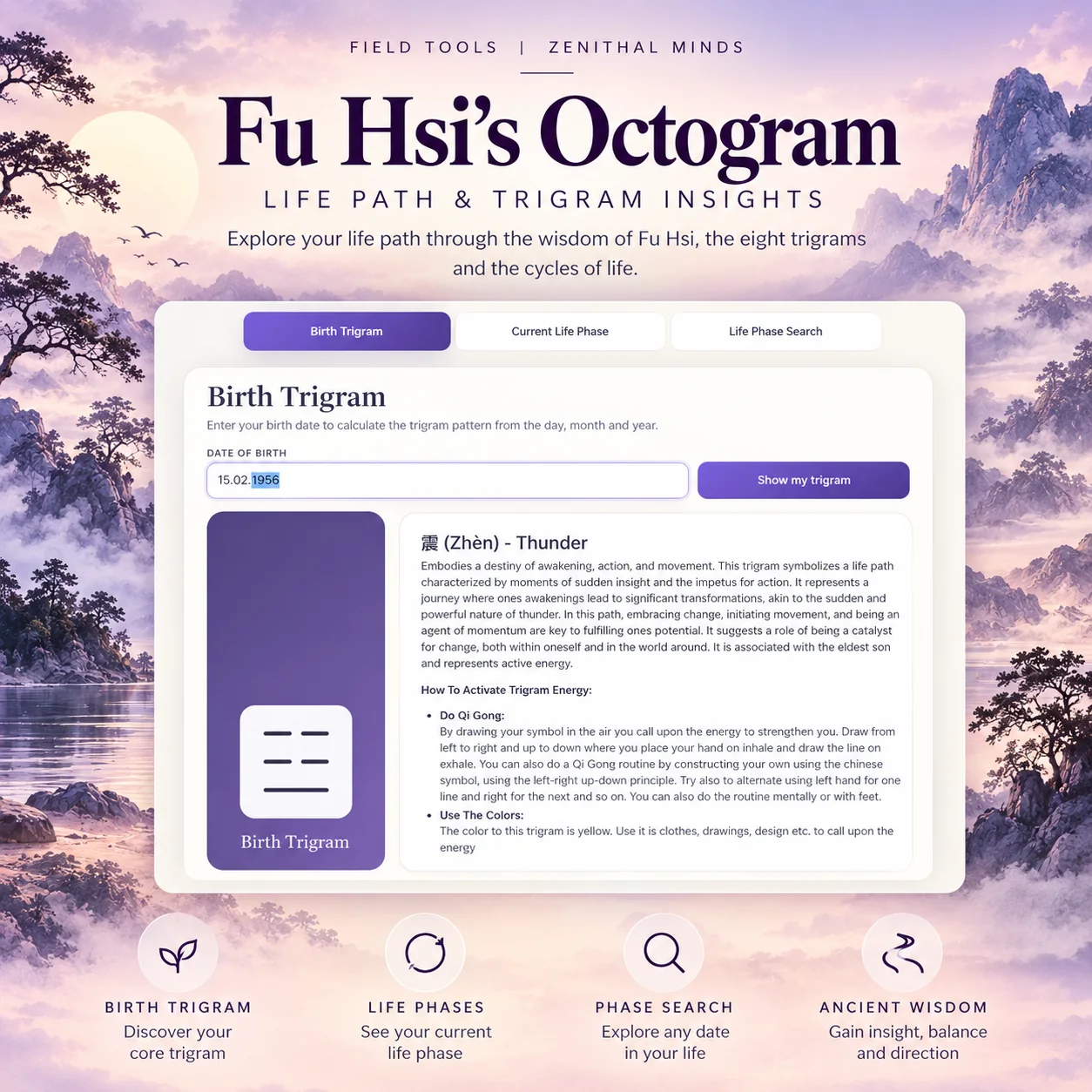
Fu Hsi's Octogram
Discover your birth trigram, explore your current life phase, and search past or future phases through Fu Hsi…
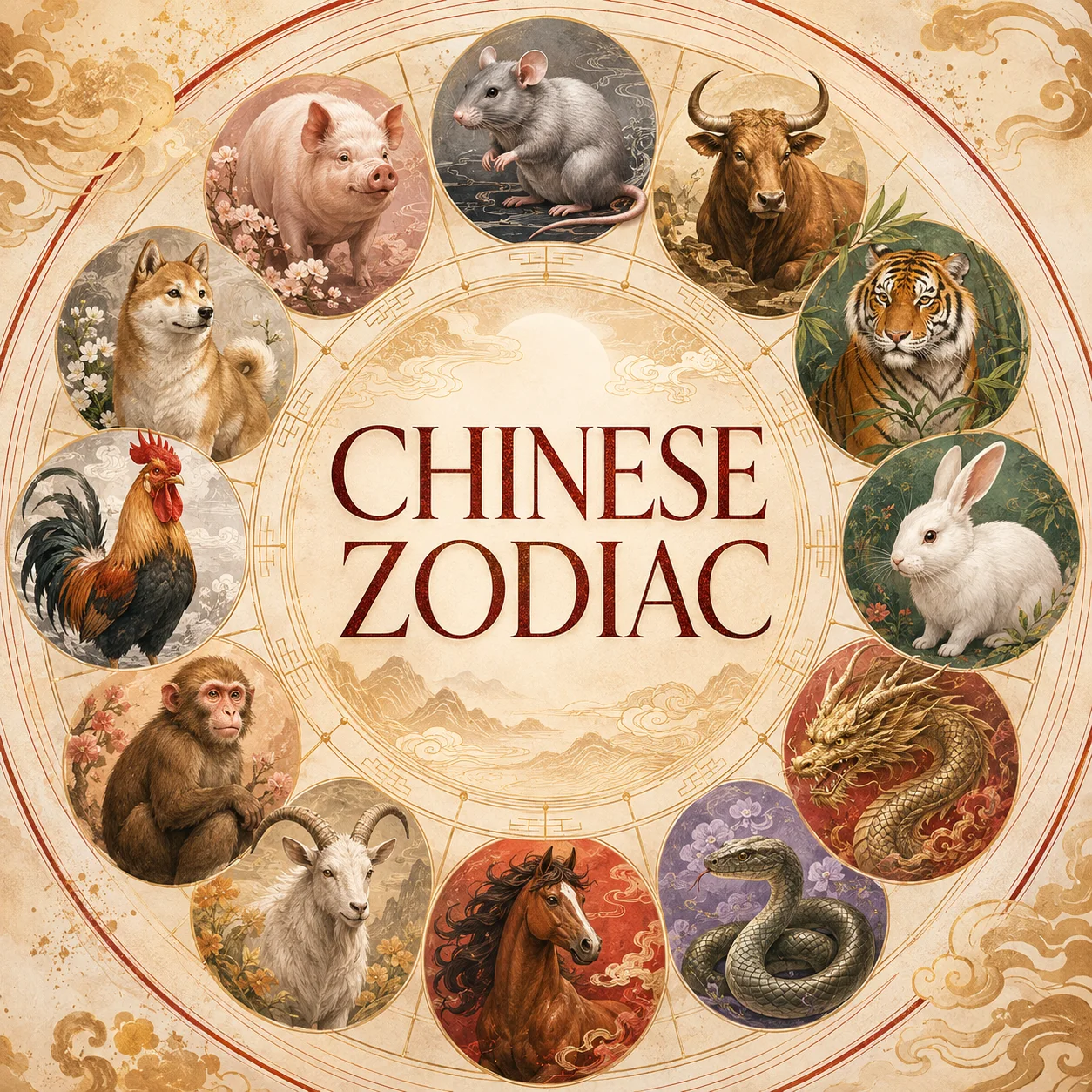
Chinese Zodiac
Discover your Chinese zodiac animal and element from your birth date, and explore its traditional traits, str…