

Before There Were Witnesses: Did the Universe Have Meaning?
If no living thing exists entirely by itself, meaning may be less like a property stored inside objects than something enacted in relation. But does that make the prehuman universe meaningless—or invite a wider account of mind, value and participation?
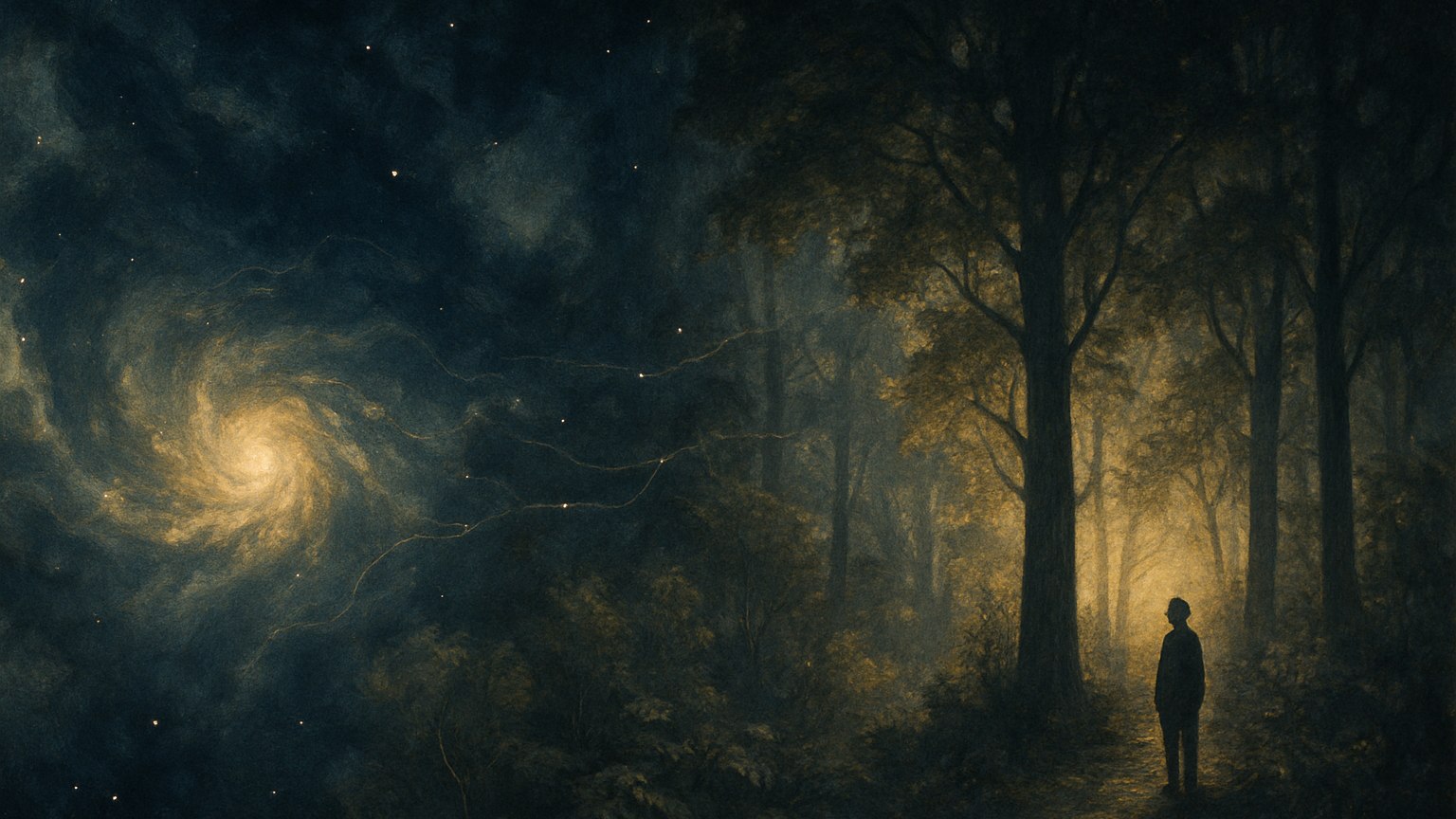
For most of its history, the universe contained no poems about itself, no grief for its extinctions, no eye lifted toward a night sky. It formed stars, scattered their elements, assembled planets and—on at least one small world—eventually produced creatures able to ask whether any of that had mattered before they arrived. The question is not merely whether the early cosmos had a purpose. It is more exacting: could there be meaning where there was no conscious being to receive, interpret or answer it?
The pressure point is relation. No living thing exists wholly by itself. An organism is sustained by air, food, temperature, ancestry, microbial partners, habitats and other organisms; even the apparently solitary life is a temporary crossing of dependencies. Human meaning, too, seems relational: a promise means something because someone can be bound by it; a wound is tragic because a life can be harmed; a landscape is beautiful because it can be encountered. Yet this intuition opens rather than closes the problem. Relation need not mean human relation, and experience need not mean human experience. The question becomes: what sort of relation is necessary before there can be meaning?
A cosmos before anyone could care
Cosmology supplies a timeline, not a verdict. The universe is about 13.8 billion years old; the first stars formed only after hundreds of millions of years, and later generations of stars forged and dispersed many of the heavier elements from which rocky planets and known life depend. Earth and its solar system formed roughly 4.6 billion years ago. These facts establish an immense interval before terrestrial observers existed. They do not establish whether that interval was empty of value, significance or experience. NASA Science, “What is the Universe?” NASA Science, “Overview”
Consider a supernova exploding in a universe devoid of sentient life. Was it beautiful? Was it terrible? Was it sacred? Ordinary language pulls in two directions. Beauty seems to require an appreciator, tragedy someone for whom something precious has been lost, and sacredness a reverent orientation. But the event’s scale, order, violence and generative consequences were not invented by a later spectator. The star really did collapse; its elements really did enter a causal history from which planets could form. The disagreement is over whether those features are already meaningful, or merely become meaningful when a being stands in a certain relation to them.
First position: meaning is made in encounter
The mind-dependent view says that meaning is not a hidden ingredient of matter. It arises when creatures with needs, projects, memories and capacities for interpretation meet a world. A river is not intrinsically “a home,” “a boundary,” “a danger” or “a symbol of renewal”; it becomes any of these in relation to forms of life. This need not imply that meaning is arbitrary. The river’s current, depth and ecology constrain what can responsibly be made of it. But significance belongs to the lived transaction, not to water considered in total isolation.
Existentialist thought gives this position its existential weight. Existentialism is not simply the slogan that people may invent any purpose they like. Its central figures attend to situated existence: beings already thrown into a world, already vulnerable, already required to choose and act. On this family of views, meaning is neither a label pasted onto neutral reality nor a cosmic instruction waiting to be decoded. It takes shape through engaged life—through commitment, anxiety, care and the ways a world becomes practically intelligible to someone. Stanford Encyclopedia of Philosophy, “Existentialism”
This view has a severe implication. A lifeless universe may have had structure, causal power and the capacity to become the condition of future meaning, but it did not yet contain beauty or tragedy in the full sense. There was no one for whom the supernova was splendid or devastating. Calling it beautiful would be a retrospective human response, legitimate as poetry but false if treated as a report about how the event was then.
The strength of this account is its honesty about the grammar of significance. “Meaningful” often implies meaningful to someone; language itself is a social practice rather than a cosmic substance. Wittgenstein’s later philosophy famously directs attention to the use of words in forms of life, which cautions against assuming that every noun corresponds to an occult object or property. Perhaps asking whether a witnessless cosmos had “meaning” is like asking whether a chess move was legal before there were games, rules or players. Internet Encyclopedia of Philosophy, “Wittgenstein, Ludwig”
Yet the linguistic objection does not end the inquiry. It may show that the word meaning has human origins and human uses; it does not settle whether those uses answer to anything beyond preference. If we say that genocide is not merely disliked but horrific, or that an unobserved forest has more than market value, we often mean to resist the thought that value begins only when humans notice it.
Second position: value waits for no witness
The objective position holds that some things are worthy, valuable or ordered independently of anyone’s response. In contemporary debates about meaning in life, objectivist theories argue that certain realities can be worthwhile in themselves rather than becoming worthwhile solely because an agent desires or approves of them. The good, the true and the beautiful are frequent candidates, although philosophers disagree sharply about their grounding and about whether objective value requires God, non-natural facts, natural flourishing, or something else. Stanford Encyclopedia of Philosophy, “The Meaning of Life”
Applied cosmically, this view permits a stronger answer: the ancient universe could have been valuable before life. Its intelligible order, its creative fecundity, or its participation in a divine reality might have made it meaningful even in total darkness. A theistic version can say that the world was never literally unwitnessed, because it was known by God. A non-theistic realist may instead say that a star’s grandeur does not need an observer any more than a mathematical truth needs one. In both cases, human consciousness discovers value; it does not manufacture value from nothing.
But the analogy with mathematics can conceal the hard part. “Two plus two equals four” appears true whether or not anyone thinks it. “This nebula is beautiful” seems to involve a response—perhaps pleasure, fitting attention or reverence—that numbers do not demand. A sophisticated objectivist can reply that beauty is a dispositional or relational property: not a private whim, but a feature that merits appreciation by suitably situated beings. That still leaves a question about an epoch with no such beings. Was beauty actual, or only available-to-be-actualized?
Ecological philosophy presses a related challenge to human exceptionalism. Environmental ethics distinguishes instrumental value—value as a means to someone else’s end—from intrinsic or non-instrumental value, value in an entity’s own right. The tradition is internally divided over which nonhuman beings, systems or wholes possess such value, and why. Still, its basic provocation is clear: a forest need not be valuable merely because it yields timber, scenery or human restoration. Stanford Encyclopedia of Philosophy, “Environmental Ethics”
That provocation does not automatically yield cosmic meaning. A living forest has forms of flourishing, vulnerability and interdependence that a sterile gas cloud may lack. But it blocks a lazy inference: because human beings are the ones who utter value-words, they must therefore be the only possible seats or sources of value. The ability to recognize worth may be an achievement of consciousness without being a license to monopolize worth.
Third position: meaning emerges when relation becomes deep enough
A third approach refuses the simple choice between pre-packaged cosmic meaning and meaning invented by isolated minds. Meaning, on this view, is emergent: it becomes possible where sufficiently rich relations produce perspective, responsiveness, memory, vulnerability and perhaps shared forms of life. It is not located in an atom, nor simply projected by a solitary ego. It appears in organized fields of mutual consequence.
Process philosophy supplies a vivid metaphysical vocabulary for this possibility. Whiteheadian process thought treats reality less as a warehouse of self-contained substances than as becoming, with event-like occasions constituted through relations to what precedes them. That is not a scientific demonstration that all things feel or that stars possess intentions. It is a philosophical proposal about what reality is fundamentally like: relational activity first, isolated things second. Stanford Encyclopedia of Philosophy, “Process Philosophy”
Buddhist dependent arising offers a different, and importantly non-identical, illumination. In classical Buddhist thought, phenomena arise in dependence on causes and conditions; this is tied to the rejection of an independent, permanent self. The point is not that the universe is one giant conscious subject, nor that everything is secretly harmonious. It is that things lack self-sufficient essence: what they are cannot be fully separated from the conditions through which they arise. Stanford Encyclopedia of Philosophy, “Mind in Indian Buddhist Philosophy”
Placed beside ecology, these traditions suggest a careful synthesis. Meaning may not be a substance hidden inside entities; it may be a mode of reality that comes into focus when relations become capable of registering one another. A predator’s hunger, a tree’s growth toward light, an animal’s avoidance of pain and a human community’s rituals do not possess the same kind or degree of meaning. Yet each complicates the image of a dead universe on one side and a fully articulate human world on the other. Meaning may have thresholds, layers and forms.
Panpsychism radicalizes this thought. It proposes that mentality or experience is fundamental and widespread in nature, partly to avoid explaining consciousness as a wholly unprecedented eruption from non-experiential matter. Contemporary panpsychists differ widely: some ascribe extremely basic experiential aspects to fundamental entities, while others prefer related views involving proto-mental properties. The famous difficulty is the combination problem: even if microscopic entities have some experiential aspect, why should that add up to a unified human or animal subject? Stanford Encyclopedia of Philosophy, “Panpsychism”
If some panpsychist account were true, the early universe might not have lacked experience altogether. But that would not straightforwardly mean it possessed meaning, beauty or sacredness in the human sense. Bare experience is not interpretation; sensitivity is not narrative; relation is not yet ethical obligation. Panpsychism therefore widens the field of possible witnesses, but it does not solve the question by declaring every particle an audience.
The danger of a human-sized universe
The charge of anthropomorphism remains powerful. We readily see intention in storms, mourning in landscapes and messages in coincidence because our minds are tuned to agents, faces and stories. Projecting these categories backward onto a prehuman cosmos may be emotionally satisfying precisely because it makes the universe resemble us. A disciplined metaphysical imagination should ask what would count against its picture. If “sacred” only means “I feel overwhelmed,” it is a report of experience, not evidence about the cosmos. If it means “deserving reverence regardless of my feeling,” it makes a larger claim and owes an account of its grounds.
But there is an equal and opposite anthropomorphism: imagining that only creatures who reason and speak as humans do can disclose or bear significance. The universe before us was not a human story waiting in silence. Yet neither was it necessarily a mere inventory of particles. The more defensible thought may be that meaning is neither an ornament added to an otherwise complete world nor an eternal sentence written before relation began. It is what can arise when reality becomes answerable—when something can be affected, can respond, and eventually can recognize that it is implicated in more than itself.
That leaves the original question unresolved, but less blurry. A witnessless universe may have had order, causal creativity and perhaps objective value; whether it was beautiful, tragic or sacred depends on what those words require. The mind-dependent account says experience completes them. The realist says reality may warrant them before anyone arrives. The emergent account says their possibility grows with the depth of relation itself. Perhaps the deepest uncertainty is not whether humans confer meaning on a mute universe, but whether our capacity for meaning is one of the universe’s ways of becoming responsive to its own long history.
Sources and references
More to read

The Afterlife of the Unlived: Do Forgotten Possibilities Still Exist?
An unrealized future can vanish from memory, paper and testimony. But does that erase it completely—or does i…
The Afterlife of the Almost: Do Unlived Futures Still Belong to Us?
Every life is crowded with futures that never arrived: the city not moved to, the apology not made, the work …
10 Lesser-Known Acupuncture Points: A Map of Pathways, Thresholds and Traditional Use
Beyond the famous hand and leg points lies a quieter acupuncture map: ten classical sites whose locations, po…
Apps to use

Fu Hsi's Name Trigram
Discover the trigram hidden within your name and explore its personality traits, strengths, weaknesses, caree…
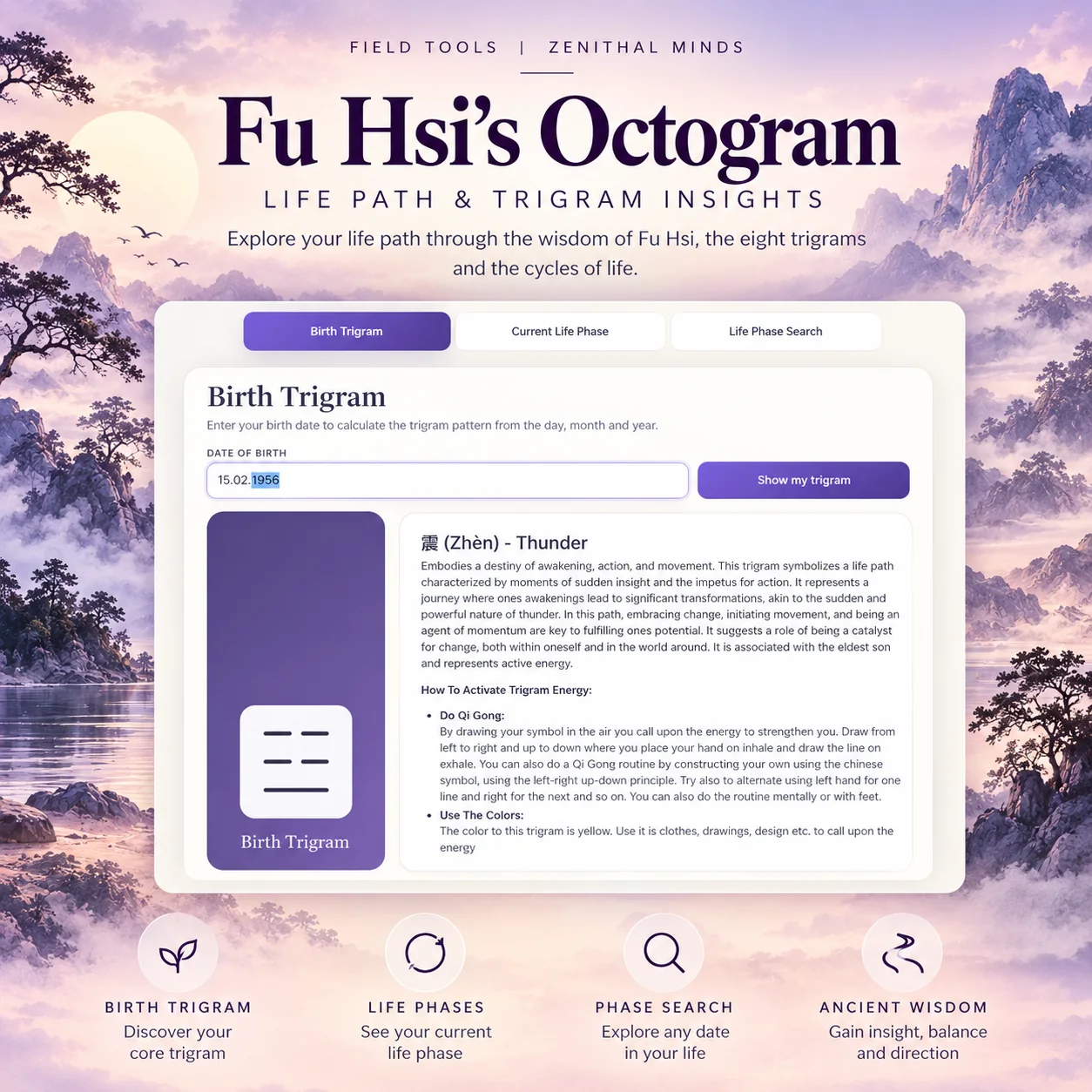
Fu Hsi's Octogram
Discover your birth trigram, explore your current life phase, and search past or future phases through Fu Hsi…
Chinese Zodiac
Discover your Chinese zodiac animal and element from your birth date, and explore its traditional traits, str…