

The Afterlife of the Almost: Do Unlived Futures Still Belong to Us?
Every life is crowded with futures that never arrived: the city not moved to, the apology not made, the work left unfinished. What if these possibilities do not simply vanish, but continue to shape the person who did not become them?
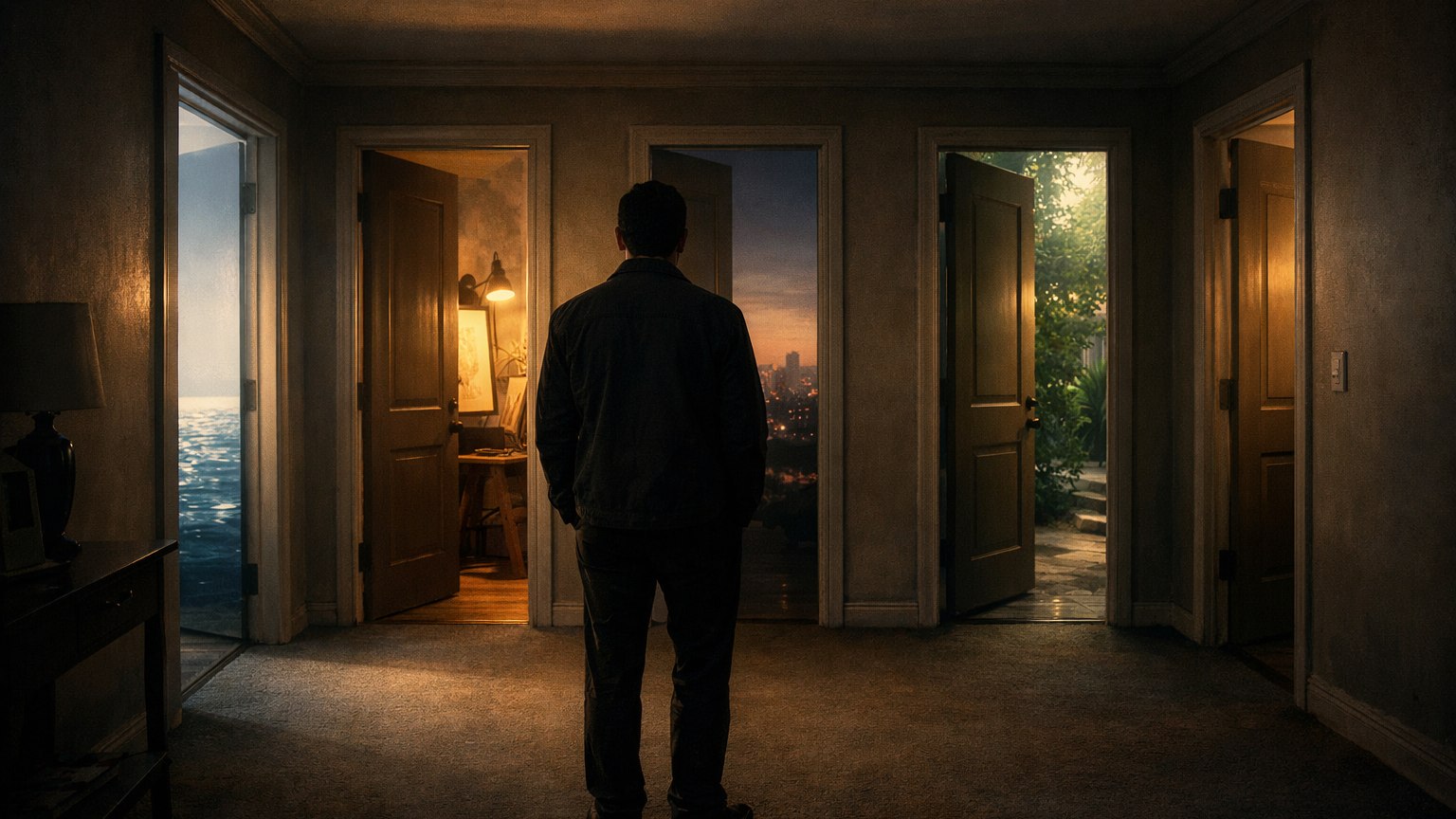
There is a peculiar kind of grief that does not have an object in the ordinary sense. Nobody has died. Nothing visible has been taken away. Yet a person can stand in a kitchen at forty, scrolling past an old photograph or hearing a song from a former season of life, and feel the presence of someone missing.
That missing person may be oneself.
Not the child one once was, nor the future self one still hopes to become. This is the self who was possible: the novelist who kept writing, the friend who made the call, the traveler who boarded the plane, the person who chose courage at precisely the hour when caution won. We tend to call these paths “missed opportunities,” as if they were doors briefly seen and then shut. But that phrase is too flat. It treats possibility as a neutral inventory of options. In lived experience, some possibilities feel more intimate than options. They feel like unfinished members of the self.
The question is not whether alternate lives exist somewhere as physical worlds. That is a different metaphysical wager. The nearer and more unsettling question is this: can an unlived future continue to exert a real claim on the life that replaced it?
Possibility is not nothing
Common sense says that what did not happen did not happen. A rejected offer, an abandoned project, an unrealized love: these are absences. They have no address, no body, no calendar entry. The actual alone appears to possess the dignity of reality.
But human beings do not live inside actuality alone. We make promises before events occur. We regret words before they can be unsaid. We prepare for disasters that may never come, and we are changed by preparations even when the disaster does not arrive. A possibility can organize attention, sacrifice, identity and action long before it becomes fact. It can also continue organizing them after it has failed to become fact.
Consider the person who trains for a career they never enter. The years have not evaporated merely because the final professional identity was not attained. Their perception may have changed; their friendships may have rearranged; their sense of what counts as a meaningful day may have deepened or narrowed. The unlived future was never simply “not real.” It was real as a force of orientation.
This suggests a useful distinction. An event is actual when it occurs. A possibility is formative when it changes the shape of a life, whether or not it occurs. The formative possible is neither a fantasy nor a completed fact. It is a kind of invisible architecture.
The person you did not become may still be speaking
We often assume that a decision settles an inner argument. Choose one city and the other disappears. Marry one person and the unlived relationship becomes irrelevant. Take the sensible job and the artistic life becomes a youthful fiction. Yet decisions may be less like executions than translations. They do not always kill their alternatives; sometimes they carry them, altered, into the chosen life.
The architect who becomes a teacher may retain an architectural hunger for structure, proportion and habitable space. The musician who becomes a parent may hear rhythm in domestic life, in footsteps, arguments and bedtime rituals. A person who declines a public life may become unusually attentive to the private dramas of others. The abandoned future may survive not as a ghost demanding resurrection, but as a sensitivity seeking another form.
This changes the meaning of regret. Regret is often treated as a sign that we have chosen wrongly. Sometimes it is. But regret may also be evidence that a capacity has gone untranslated. It says: something in me recognized a direction, and I have not yet found where to put its energy.
That is a more generous reading than the culture of optimization allows. Optimization imagines that every life contains one correct sequence of choices, and that wisdom consists in locating it early enough. But a life is not a route-planning problem. Its meanings are not all visible at departure. A choice can be irreversible without being the final verdict on the desire that animated it.
A strange proposition: futures may need witnesses
Here is a bolder possibility. Perhaps unrealized futures do not persist primarily in us, as private memories or neural traces. Perhaps they persist between us: in the social, material and imaginative field that a person’s almost-life has already touched.
A draft novel influences a conversation with a friend. The conversation alters the friend’s courage. The friend makes a decision that changes a family. An abandoned plan for a community garden leaves behind a sketch, a question, a newly noticed vacant lot. Years later, somebody else acts. No mystical mechanism is required for this thought. A possibility, once sincerely entertained, may enter circulation. It can become available to other minds.
But the deeper proposition goes further. What if the moral significance of a possibility does not depend entirely on whether its originator carries it through? What if a future imagined by one person is, in some limited sense, entrusted to the world?
This would make personal ambition less proprietary. The dream of making a film, opening a workshop, repairing a family silence or learning a language would not be merely a private possession to either achieve or fail. It would be a proposal offered to reality. If one person cannot embody it, perhaps its essential gesture can reappear elsewhere, changed beyond recognition.
That does not erase disappointment. It may make disappointment more exact. The grief is not that an imagined future was worthless because it failed. The grief is that one was meant to be its particular witness: the one who would have given it this voice, this body, this timing, this texture of attention.
The paradox of fidelity
If unlived futures retain a claim on us, must we remain faithful to every former self? Clearly not. A life devoted to preserving all its abandoned possibilities would become unlivable. One cannot be equally loyal to every road not taken. Some imagined selves deserve to be released because they were built from fear, imitation, vanity or a version of success that no longer feels alive.
The task, then, is not fidelity to every old dream. It is fidelity to the deeper question from which a dream arose.
Someone may think they mourn becoming a famous painter, when what they truly mourn is a life with sustained contact with color, solitude and making. Someone may think they mourn a former lover, when they mourn the self who once believed intimacy could be spontaneous. Someone may think they mourn an abandoned city, when they mourn the possibility of anonymity: the freedom to meet themselves without an inherited audience.
This is the practical use of metaphysics. It asks us not to revive the exact image that failed, but to listen beneath it. Which future is asking to be reborn? Which future is asking merely to be understood and buried? Which one is still waiting for translation?
How to meet an almost-life without being ruled by it
A useful exercise is to name one unlived future precisely. Not “my better life,” but “the life in which I studied marine biology,” or “the life in which I told my brother the truth,” or “the life in which I made work that nobody had requested.” Then ask four questions:
- What did this future promise me? Freedom, recognition, belonging, skill, beauty, repair?
- What part of that promise was bound to the original form? Perhaps the city, title or person mattered deeply. Perhaps they were only symbols.
- What capacity did I develop while moving toward it? Attention, endurance, discernment, tenderness, nerve?
- Where could that capacity become active now? Not as a consolation prize, but as a living continuation.
This is not an instruction to turn every regret into a project. Some losses should remain losses. They teach proportion. They protect us from the fantasy that the self can be endlessly revised without cost. There is dignity in admitting that certain doors closed, and that one will never know what lay behind them.
Yet accepting finitude need not mean accepting inner foreclosure. The past cannot be reopened, but the meaning of the past is not fixed at the moment it becomes past.
The life you chose is not the only life you carry
Perhaps identity is not a single line extending from birth toward death. Perhaps it is more like a woven fabric whose absent threads still affect the pattern. The person you did not become is not necessarily an accusation. They may be an unrecognized collaborator.
They can remind you that a settled life is not a completed life; that an old desire may contain a value you have not exhausted; that failure sometimes leaves behind an instrument rather than a ruin. The question is not whether you can return to every unopened door. You cannot.
The question is whether you can learn to hear the quiet intelligence in what almost happened. Not every almost is a command. But some are messages from the wider life you are still, even now, in the act of becoming.
More to read
The Afterlife of the Unlived: Do Forgotten Possibilities Still Exist?
An unrealized future can vanish from memory, paper and testimony. But does that erase it completely—or does i…
10 Lesser-Known Acupuncture Points: A Map of Pathways, Thresholds and Traditional Use
Beyond the famous hand and leg points lies a quieter acupuncture map: ten classical sites whose locations, po…

The Inner Pass and the Outer Pass: PC6, SJ5, and the Art of Emotional Sovereignty
PC6 Neiguan and SJ5 Waiguan sit on opposite sides of the forearm like two doors in one wall. Read philosophic…
Apps to use

Fu Hsi's Name Trigram
Discover the trigram hidden within your name and explore its personality traits, strengths, weaknesses, caree…

Fu Hsi's Octogram
Discover your birth trigram, explore your current life phase, and search past or future phases through Fu Hsi…

Chinese Zodiac
Discover your Chinese zodiac animal and element from your birth date, and explore its traditional traits, str…