
Can a Future Witness Give Meaning to a Past That Had None?
A supernova can precede every witness and still become part of a story of life. But does later understanding make the ancient event meaningful, or merely make meaning possible now?
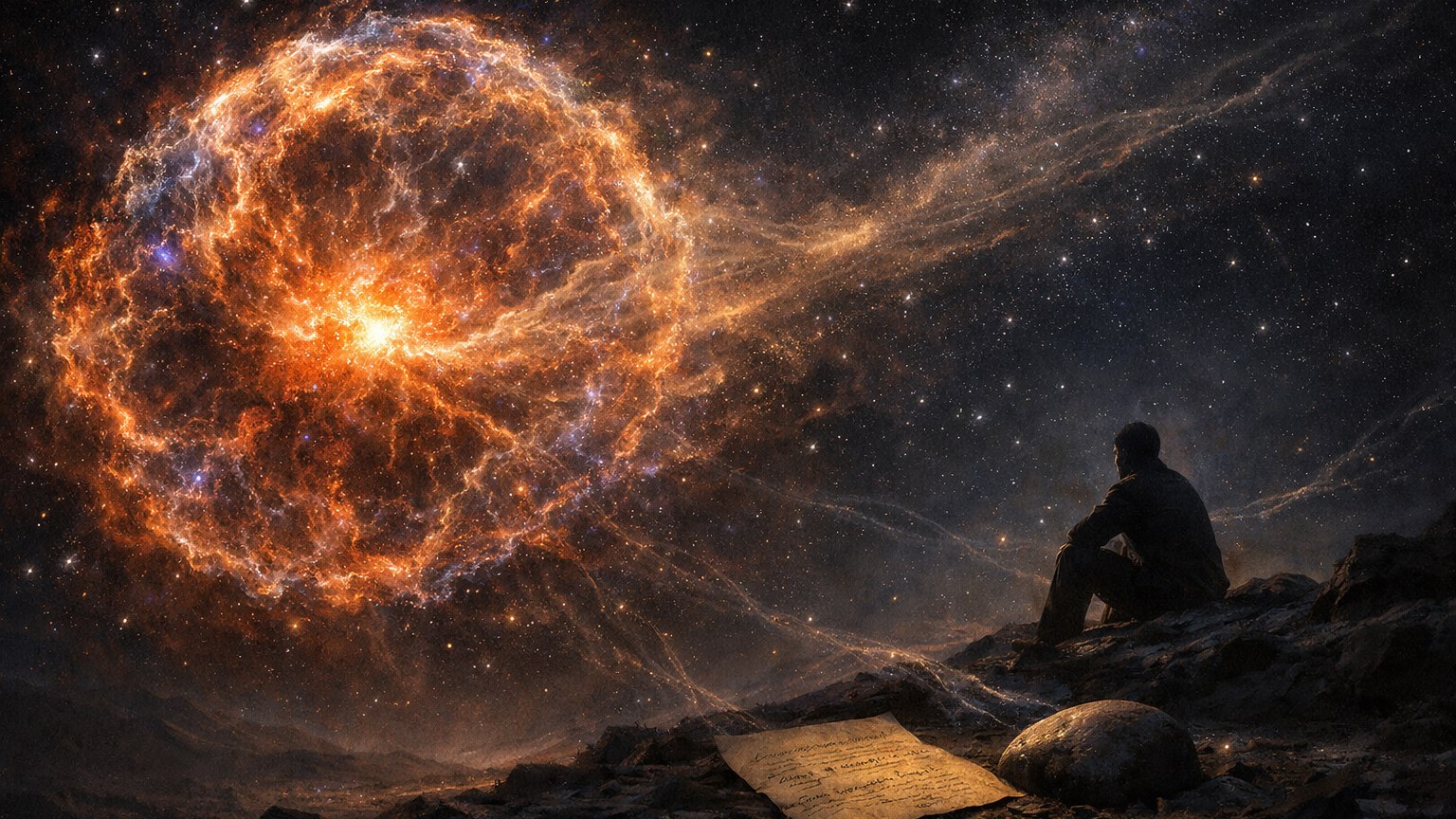
Imagine a supernova exploding in a region of space where no eye, instrument, organism or mind will exist for billions of years. The event is violent, radiant and indifferent. It leaves behind dispersed matter that may eventually enter new stars, planets and living bodies. NASA’s account of the chemical origins of life notes that several elements essential to life are made in stars and stellar explosions, while supernovae produce heavier elements. NASA, “Where do life’s building blocks come from?”
Much later, on one small planet assembled from such history, a conscious being learns what a supernova is. It understands that its own blood, bones, tools and questions depend on a long cosmic traffic of matter. The explosion now appears not merely as an occurrence, but as an ancestor. A tempting conclusion follows: the future witness has given meaning to a past that, at the time, had none.
The temptation is worth taking seriously because it asks more than whether we tell stories about the past. It asks whether meaning is something an event has only when it is received—whether consciousness reaches backward, not to alter physical facts, but to complete what those facts are. Perhaps an unwitnessed universe is not meaningless in the thin sense of being empty of structure or causation. Perhaps it is unfinished in the thicker sense that nothing yet exists for which anything can matter.
Four things that are easily confused
The supernova had causal importance whether or not anyone later knew it. If material from stellar processes enters later systems, that is a physical relation: earlier conditions help make later conditions possible. Causal importance does not wait for praise, grief or interpretation. It is what an event does in a chain of events.
Retrospective narrative significance is different. The explosion becomes significant to us when it is placed within a story: “this is part of the material history from which observers emerged.” That sentence was not available before observers, languages and scientific inquiry existed. It is a new relation between an old event and a later understanding. Its novelty is real, but it is a novelty in the world’s web of relations, not automatically a revision of the explosion’s earlier physical character.
Intrinsic value is a stronger and more controversial category. Some accounts hold that value depends fundamentally on attitudes, desires or experience; others argue that some things can be worthwhile whether or not anyone recognizes them. Contemporary philosophical debates about meaning distinguish subjective, objective and hybrid views rather than assuming that being valued and being valuable are identical. Stanford Encyclopedia of Philosophy, “The Meaning of Life” If intrinsic value exists, then an unwitnessed supernova might possess value without a future witness. If it does not, a witness may be required for value, but not for causation.
Then there is the strongest claim: that later interpretation somehow alters the past itself. This should not be smuggled in merely because the first three distinctions are porous in ordinary speech. It is one thing to say, “The supernova now means something.” It is another to say, “The supernova, billions of years ago, was different because we later understood it.” The first claim concerns a newly actual relation. The second appears to require a new past.
The anonymous letter and the recovered grave
Consider an anonymous letter stored unread in an archive for two centuries. When a historian discovers that it identifies a betrayed dissident, the letter becomes a clue, an accusation, perhaps a fragment of justice. Or consider an unmarked grave whose name is recovered through records, testimony and patient work. What was hidden becomes publicly mournable.
In neither case need we say that the paper acquired new ink or that the burial became, in its own historical moment, less anonymous. Yet something more than private feeling has happened. A person previously absent from collective memory has entered public acknowledgment; present duties may change; descendants may gain knowledge, standing or grounds for repair. Philosophers of reconciliation describe acknowledgment of wrongs and victims, trust-building and the reassertion of victims’ membership in a moral community as central concerns, while memorials can help shape collective memory and identity. Stanford Encyclopedia of Philosophy, “Reconciliation”
This is not cosmetic. Historical repair can change institutions, obligations and the possibilities of mourning. But its moral force depends on refusing the fantasy that nothing happened until we noticed. The recovered name matters precisely because the person’s life and loss were already real. Recognition does not manufacture the wrong; it meets a past reality that had been denied, obscured or left without a public witness.
A childhood event offers the intimate version. A sentence heard at ten may be experienced as trivial, then understood at forty as cruel, formative or unexpectedly protective. The adult does not send a new mental state back into the child’s room. But the adult’s life is a continuing whole, and its earlier parts are now differently situated within that whole. What changes is not the utterance’s acoustics. It is the significance the utterance bears in a larger personal pattern.
What sort of time could allow this?
On presentism, only the present exists; past events do not exist alongside current ones. On eternalism, often associated with the block universe, past, present and future events all exist at their temporal locations. A third position, the growing block theory, holds that past and present exist while the future does not yet exist, so reality increases as new events are added. These are competing ontologies, not merely different moods about time. Stanford Encyclopedia of Philosophy, “Time”
The block universe gives the cleanest answer to our question. The supernova, the later observer and the observer’s thought are all parts of one four-dimensional reality. The relation “is understood by” does not suddenly reach backward; it is tenselessly true that the later thought concerns the earlier event. In this picture, meaning is not poured backward through time. Rather, the complete temporal pattern contains both the explosion and its eventual intelligibility.
That answer preserves consistency, but it has a cost. It can make the arrival of meaning feel less like an achievement than like a coordinate. Presentism preserves the drama of discovery more vividly: when the observer comes to understand, a genuinely present act of interpretation occurs. Yet presentism still need not imply that the past has been rewritten. It can say that new truths are now assertible about an event that is no longer present—for example, that it is now known, mourned or scientifically explained—without saying the event then possessed a witness it did not possess.
Process-oriented metaphysics makes the question more fertile. Alfred North Whitehead’s philosophy treats reality as becoming rather than as a completed inventory of things. In Process and Reality, he describes the past as a nexus of actualities and the future as real possibility rather than completed actuality; new occasions arise from and take up what has come before. Alfred North Whitehead, Process and Reality On such a view, a later consciousness does not change an earlier event’s settled actuality. But it can add something genuinely new to reality: a further event in which the past is felt, interpreted and carried forward.
This yields a more exact proposition: a future witness cannot make an earlier event have been witnessed, but can make that event newly meaningful in the expanding reality that includes both. The transformation is neither merely verbal nor retrocausal. It is relational and cumulative. The ancient supernova remains what it was in its own occurrence; yet the universe becomes more than it was when an observer makes that occurrence part of wonder, explanation, art or care.
Does redemption change what suffering was?
Religious language often presses harder than this. Redemption can mean that an injury, death or apparent waste is gathered into a good not visible from within the original moment. Christian accounts of atonement, for example, include models in which Christ acts representatively in relation to a collective humanity. Stanford Encyclopedia of Philosophy, “Atonement” In this register, a later act does not simply comment on an earlier wound; it changes the wound’s place within an ultimate drama.
That is a metaphysical and theological hope, not evidence that the cosmos literally edits its own record. Still, it identifies an important possibility. To redeem a past need not mean declaring that pain was secretly not pain, or that injustice was acceptable because a later benefit followed. It may mean refusing to let harm have the final interpretive word. Secular historical repair makes a parallel move without requiring cosmic revision: later people can establish truth, name victims, return what can be returned, compensate where appropriate and change the social world that continues to inherit the injury.
The conceptual objection arrives when this language slides from “the past has acquired a new place in our world” to “the past itself has become other than it was.” A new description is not necessarily a new past. The distinction matters ethically as much as logically. If later redemption erased earlier suffering, the victim would be asked to surrender the reality of what occurred. But if redemption adds a relation—being remembered, answered for, mourned or taken up into a larger good—it can honor the irreversibility of the event while denying its isolation.
The witness does not create the star—but may complete a relation
Perhaps the deepest error is to imagine only two options: either meaning was already sitting inside the supernova like a hidden mineral, or human minds arbitrarily manufacture it. There is a third possibility. Meaning may be neither an intrinsic ingredient of an isolated event nor a fiction imposed upon it. It may be a relation that requires both a real past and a later capacity to receive that past.
Under that description, the future witness gives meaning without giving the past a different history. The supernova did not need us in order to explode, to disperse matter or to condition later worlds. But it needed something like us—or some later locus of awareness—before it could become known as belonging: belonging to a history of matter, life and self-questioning.
The strange consequence is that consciousness may not be the universe’s author, or even its judge. It may be the place where reality becomes answerable to itself. A witness does not make the ancient starburst occur. Nor does witnessing prove that the event had a purpose. But when the universe produces a being able to understand its own ancestry, an old explosion enters a new mode of existence: not newly physical, not retrospectively altered, but newly held in meaning. The past remains intact. Reality, however, has become capable of remembering what it was.
Sources and references
- Where do life's building blocks come from? - NASA Science | https://science.nasa.gov/astrobiology/learning-resources/alp/where-lifes-building-blocks-come-from/
- Time (Stanford Encyclopedia of Philosophy/Fall 2025 Edition)
- The Meaning of Life (Stanford Encyclopedia of Philosophy)
- Reconciliation (Stanford Encyclopedia of Philosophy)
- Atonement (Stanford Encyclopedia of Philosophy)
- Process and Reality — the Gifford Lectures, 1929 — page 93
More to read
The Afterlife of the Unlived: Do Forgotten Possibilities Still Exist?
An unrealized future can vanish from memory, paper and testimony. But does that erase it completely—or does i…
The Afterlife of the Almost: Do Unlived Futures Still Belong to Us?
Every life is crowded with futures that never arrived: the city not moved to, the apology not made, the work …
10 Lesser-Known Acupuncture Points: A Map of Pathways, Thresholds and Traditional Use
Beyond the famous hand and leg points lies a quieter acupuncture map: ten classical sites whose locations, po…
Apps to use

Fu Hsi's Name Trigram
Discover the trigram hidden within your name and explore its personality traits, strengths, weaknesses, caree…

Fu Hsi's Octogram
Discover your birth trigram, explore your current life phase, and search past or future phases through Fu Hsi…

Chinese Zodiac
Discover your Chinese zodiac animal and element from your birth date, and explore its traditional traits, str…