Crystals as Keepers of Intention: Can Matter Hold a Promise?
If an intention can be entrusted to a crystal, where does its memory reside—in the stone, the mind, or the relationship between them? An exploration of manifestation, sacred objects, and the persistence of meaning.
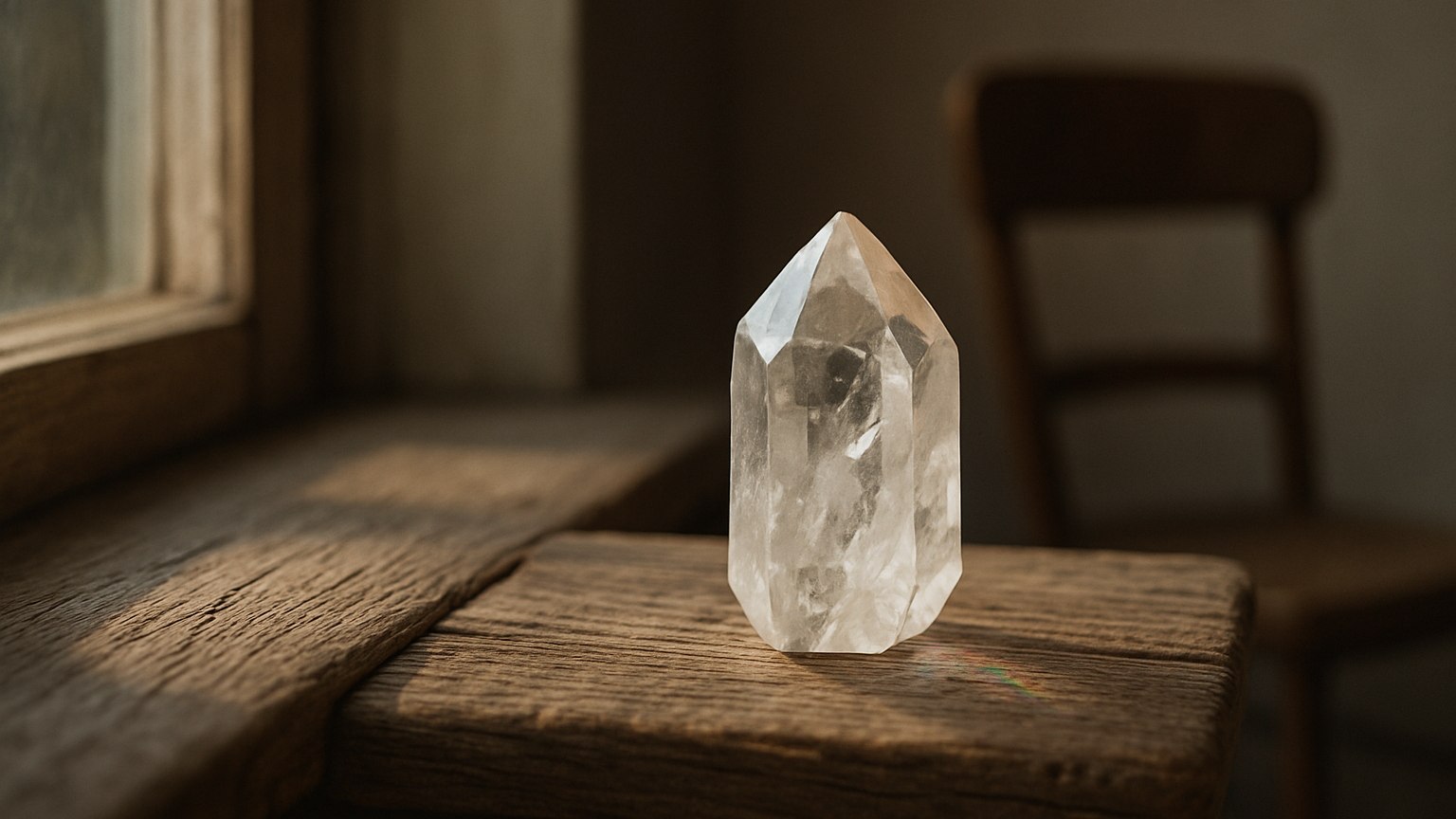
Imagine entrusting a crystal with a promise: to meet uncertainty with courage. You hold it, give the intention words, and leave it beside a window. Then you return to ordinary life. Within the metaphysical premise explored here, the encounter has not ended. The crystal has received something of your conscious purpose, preserves its energetic imprint, and continues amplifying it after your attention moves elsewhere.
Consider that premise from within rather than immediately translating it into something else. It proposes that attention can establish a relationship with matter that outlasts the moment of attention. The crystal becomes a keeper: not necessarily a thinking companion, but a material presence entrusted with continuity. Its deepest promise is not simply that it will help you obtain something. It is that an intention need not disappear whenever you stop thinking about it.
What would it mean for matter to remember?
We should distinguish three possible meanings of crystalline memory. Structural memory would mean that a material state preserves information about an earlier interaction. Symbolic memory would mean that an object carries a significance that can be encountered again. Energetic memory, in the esoteric sense considered here, would mean that the crystal retains an imprint of intention beyond an ordinary physical inscription. These are different propositions, not interchangeable descriptions of one established mechanism.
Crystallography supplies a compelling image without settling the metaphysics. The International Union of Crystallography defines crystals through long-range spatial order in their constituent atoms, ions, or molecules. Most familiar crystals have periodic arrangements; others possess order without ordinary three-dimensional periodicity. What makes a crystal crystalline is therefore not its transparency or supposed spiritual purity, but its organization. The IUCr definition establishes this physical distinction—not the storage of human wishes.
Philosophically, such order invites a question: could memory mean the persistence of a pattern rather than the recollection of an experience? That broader definition makes room for nonbiological memory, but it also creates a responsibility. A persistent structure does not automatically record everything that encounters it. Calling a crystal a keeper of intention still leaves us asking what, precisely, has changed—and where.
Perhaps, in a symbolic interpretation, the change belongs to the relationship. A stone selected during a moment of resolve is no longer interchangeable with every similar stone. Its mineral composition need not change for its place in a life to change. Here, “the crystal remembers” could mean that a commitment has acquired an enduring address.
Does manifestation begin with will—or with recognition?
One influential account of manifestation appears in Neville Goddard’s Feeling Is The Secret. Goddard presents consciousness as fundamental reality and describes consciously chosen ideas being impressed upon the subconscious through feeling. His instruction is to inhabit the felt reality of an accomplished desire rather than merely long for its future arrival. These are metaphysical teachings about causation, not established descriptions of how external events must unfold. Goddard’s text locates the creative process in consciousness; it does not establish a crystal-programming method.
Bringing a crystal into that framework produces an interesting tension. If consciousness is the source, why would an external object be necessary? One possible interpretation is that it is not necessary at all. The crystal serves as a material expression of an inwardly assumed state: courage given a location, openness given a form. It does not replace consciousness; it makes a chosen orientation tangible.
A stronger energetic interpretation would assign the stone an additional role: receiving the intention and sustaining its influence independently of renewed attention. The philosophical difference matters. In the first account, the crystal participates through a relationship with its keeper. In the second, something is claimed to continue within or through the crystal itself. Neither account should quietly borrow the other’s plausibility.
This also changes the meaning of amplification. Must an amplified intention become more forceful? Or could amplification mean greater coherence—less conflict between what one says one wants and how one lives? A crystal entrusted with courage might then invite a difficult conversation rather than promise a life without difficulty. Manifestation becomes a question of participation, not merely acquisition.
Correspondence: when form becomes a language
In the opening of Three Books of Occult Philosophy, Heinrich Cornelius Agrippa describes an interconnected hierarchy of elementary, celestial, and intellectual worlds, with influences passing through stars, elements, plants, metals, and stones. Within that cosmology, material objects participate in a larger order rather than standing spiritually isolated. This is a documented occult worldview, not evidence that contemporary crystal practices descend unchanged from it. Agrippa’s text provides the historical framework.
Read through such a philosophy of correspondence, crystalline geometry can become a contemplative language. Repetition might symbolize fidelity; symmetry, balance; the relation between a small arrangement and a larger form, the possibility of shared principles across scales. “Sacred geometry” here names an interpretation of form as spiritually meaningful—not a demonstrated mechanism by which geometry grants wishes.
The same care clarifies resonance. Physical resonance concerns the response of a system to particular driving frequencies. Symbolic resonance means that something feels meaningfully consonant with an experience or aspiration. An energetic resonance between crystal and intention would be a further metaphysical claim. The symbolic connection can be fruitful without supplying evidence for the energetic one.
There is also a challenge within correspondence itself. If a stone can signify anything whatsoever, has correspondence become arbitrary? A thoughtful interpretation should explain why this form illuminates this intention—and remain open to a form that resists the preferred meaning. Otherwise, the crystal becomes less a partner in inquiry than a surface on which every desire finds its own reflection.
Programming as a ritual of relationship
Contemporary crystal instruction often organizes practice around cleansing, intention-setting, and renewed engagement. The commercial practitioner source Energy Muse describes cleansing as clearing previous influences, recommends several ritual methods, and presents crystals as amplifiers of intention. It also advises regular reconnection and continued personal effort. This documents a contemporary belief system, not independently verified energetic effects. Its crystal FAQ is useful as a practitioner account, rather than an authority on physical mechanisms.
As a philosophical reading, cleansing marks a threshold: previous associations are released. Programming establishes a purpose. Charging imagines renewal or replenishment. Maintenance asks whether the commitment still fits. These interpretations need not exhaust what practitioners believe is happening; they reveal the ritual’s internal grammar.
Yet the language of programming deserves scrutiny. It imagines matter as obedient equipment. What changes if we speak instead of dedication? Programming asks, “What will this object do for me?” Dedication asks, “What relationship am I entering?” The second formulation leaves room for the possibility that an intention should change its keeper, not merely command circumstances.
For a hypothetical personal ritual, the intention might therefore be a commitment rather than an ultimatum: “I will practice speaking honestly,” rather than “This particular person must respond as I desire.” Returning to the stone could become an occasion to ask what honesty now requires. That is a proposed reflective practice, not a promise of supernatural results.
Sacred objects—and the limits of resemblance
Ancient Egyptian amulets offer a specific historical parallel. According to the Metropolitan Museum of Art, their attributed powers could depend on combinations of material, color, shape, inscriptions, spoken words, and ritual actions. The object’s efficacy was understood through more than its substance alone. The museum’s account documents a relationship among matter, symbolism, and ritual, without establishing equivalence with modern crystal manifestation.
Other objects organize spiritual attention without necessarily being understood as repositories of personal wishes. The Met describes an Islamic string of beads as facilitating focus and concentration during prayer. That example cautions against collapsing prayer beads, talismans, sacred symbols, and programmed crystals into one universal technology. Similar material forms can belong to different understandings of spiritual agency.
The useful connection is therefore a question, not a genealogy: how does a physical object allow a fleeting act of devotion to become available again? A spoken intention disappears as sound. A dedicated object remains encounterable. Perhaps its significance lies partly in this difference between the duration of an act and the duration of its material companion.
Where does the intention live?
Philosophy offers alternatives to a simple division between active mind and passive surroundings. In The Extended Mind, Andy Clark and David Chalmers argue that environmental resources can, under suitable conditions, participate in cognitive processes. Their thought experiment involving a reliably consulted notebook asks whether memory must remain inside the body. Their argument concerns functional integration, not spiritual energy.
By analogy—not as their conclusion—a crystal regularly encountered in a reflective practice might belong to a larger arrangement through which an intention is sustained. But the analogy has a revealing limit: a notebook contains retrievable entries. A crystal without an inscription may depend on its keeper to recover the meaning. If that relationship vanished completely, what would remain of the intention?
Panpsychism opens another possibility by treating mentality as fundamental and widespread in nature. As the Stanford Encyclopedia of Philosophy explains, this need not mean that a rock possesses a unified mind, thoughts, or desires; some versions concern experiential properties at a more basic level. The philosophical position challenges assumptions about matter without establishing that crystals understand instructions.
The enduring question is therefore not simply whether the stone is active or passive. It is whether intention belongs exclusively to a moment of conscious willing, or can become distributed through commitments, objects, places, and ways of returning. That possibility does not justify blaming anyone’s illness or misfortune on an insufficiently positive mind, nor does it make other people’s freedom an obstacle to be spiritually overridden.
Perhaps the crystal’s most expansive invitation is to distinguish absence from awareness from absence of significance. Must a promise be consciously rehearsed every instant to remain a promise? If an intention has shaped what we keep nearby, what we return to, and how we prepare to meet the world, where does its activity end? The crystal may be imagined as an energetic keeper, understood as a symbolic companion, or left as an unresolved presence. In each case, it asks whether attention must hold meaning continuously—or whether meaning can sometimes hold a place for attention’s return.
Sources and references
- Crystal - Online Dictionary of Crystallography | https://dictionary.iucr.org/Crystal
- Feeling Is The Secret
- Three Books of Occult Philosophy or Magic
- FAQ > CRYSTAL FAQ'S
- Ancient Egyptian Amulets
- Beads
- The Extended Mind
- Panpsychism
More to read
The Afterlife of the Unlived: Do Forgotten Possibilities Still Exist?
An unrealized future can vanish from memory, paper and testimony. But does that erase it completely—or does i…
The Afterlife of the Almost: Do Unlived Futures Still Belong to Us?
Every life is crowded with futures that never arrived: the city not moved to, the apology not made, the work …
10 Lesser-Known Acupuncture Points: A Map of Pathways, Thresholds and Traditional Use
Beyond the famous hand and leg points lies a quieter acupuncture map: ten classical sites whose locations, po…
Apps to use
Fu Hsi's Name Trigram
Discover the trigram hidden within your name and explore its personality traits, strengths, weaknesses, caree…
Fu Hsi's Octogram
Discover your birth trigram, explore your current life phase, and search past or future phases through Fu Hsi…
Chinese Zodiac
Discover your Chinese zodiac animal and element from your birth date, and explore its traditional traits, str…