

The Small Ceremony of Relief: Why Modest Care Rituals Matter When We Cannot Fix the Body
A wristband for nausea, a cup of tea, a cold cloth, three slow breaths, a text message asking “how is it now?”—small rituals can feel disproportionately important during discomfort. Their value may lie not in cure, but in agency, attention, relationship and a wiser way of accompanying uncertainty.
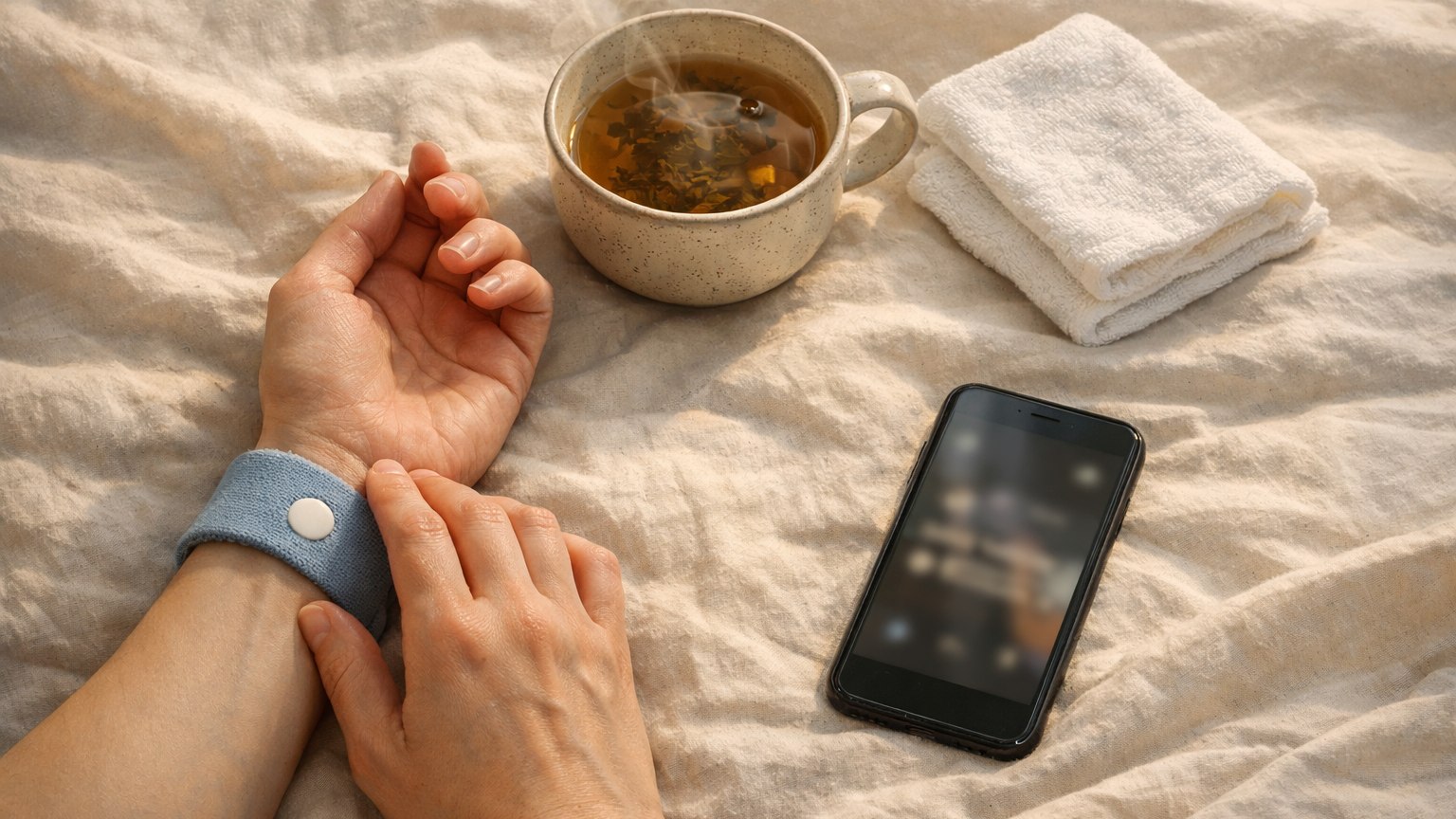
When nausea rises, the body makes the future very small. There is the next swallow, the next wave, the question of whether to lie still or move, eat or wait. In that narrowed world, pressing a point on the inner wrist can feel like more than a technique. It is a small declaration: I am here; I can do one thing.
That is the puzzle of modest care rituals. A nausea wristband, ginger tea prepared in a familiar mug, a cool cloth on the forehead, counted breathing, a hand held during a migraine, a nightly check-in from someone who knows the pattern—none promises dominion over illness. Some may have specific physiological effects in particular situations; others may chiefly change the experience around a symptom. Yet they become especially compelling precisely where discomfort is real and control is limited.
It is tempting to ask which explanation is the true one: mechanism, distraction, placebo, reassurance, habit, love. But the more useful answer may be that small rituals often work, when they work at all, on several levels at once. They can be practical without being curative, meaningful without being magical, and medically responsible without pretending that every bodily problem can be solved at home.
The wristband is not one thing
Acupressure offers a revealing entry point because it sits at the border of biomedical research and older healing traditions. In Chinese medicine, pressure at the P6 or PC6 point—on the inner forearm near the wrist—is understood within a larger account of bodily balance and the movement of qi. A secular clinical account does not need to settle that metaphysical question to investigate outcomes. Research on stimulation of PC6 for postoperative nausea and vomiting has included needles, electrical stimulation and noninvasive acupressure bands; a recent Cochrane network meta-analysis reviewed these approaches alongside antiemetic drugs and sham interventions. The evidence is specific to contexts and techniques, not a license to treat every kind of nausea as interchangeable. Stimulation of the wrist acupuncture point PC6 for preventing postoperative nausea and vomiting: a network meta-analysis
That specificity matters. A double-blind trial of acupressure bands during labour, for example, found no significant difference from sham bands in nausea, vomiting, rescue medication or satisfaction. A band may be harmless and comforting for many users; that is not the same as demonstrating a reliable treatment effect in every setting. A randomised, double-blinded, placebo-controlled study of acupressure wristbands for the prevention of nausea and vomiting during labour and delivery
Still, reducing the wristband to either “proven medicine” or “mere placebo” misses what a person may actually be doing with it. They are locating a point, fastening something, making a repeatable response to an unpredictable sensation. The gesture gives the episode a beginning: when this starts, this is how I meet it. That structure can matter even if its symptom-specific effect is modest, uncertain or absent on a given day.
Ritual begins where control thins out
Anthropologists have long noticed that rituals intensify around consequential uncertainty. Bronisław Malinowski’s famous interpretation of Trobriand Islander practices contrasted more predictable lagoon fishing with riskier open-sea expeditions, proposing that ritual helps people continue acting where technical mastery runs out. His broad functional account has been debated, and no one ethnographic example should stand in for all religious life. But the underlying question remains sharp: what do humans do when action is required but outcomes cannot be commanded?
Experimental work gives that old question a more modest, testable form. In a field study in Mauritius, women from a Marathi Hindu community who performed their habitual temple ritual after an anxiety-inducing task showed greater reductions in reported and physiological anxiety than participants who sat quietly; the authors also stressed important alternative explanations, including familiarity with the setting, symbols and differences in activity. The study supports neither a universal ritual mechanism nor a verdict on religious truth. It does show why it is too simple to treat ritual as irrational residue. The role of ritual behaviour in anxiety reduction: an investigation of Marathi religious practices in Mauritius
A related laboratory study tested repetitive, orderly movements and words against less patterned activity. Its results pointed in the predicted direction but had wide confidence intervals that prevented confident general conclusions beyond the sample. That caution is instructive. Repetition may help some people because predictable action supplies a small island of order; it is not a universal antidote to anxiety. Effects of predictable behavioral patterns on anxiety dynamics
This may explain the appeal of making tea during a flare. The kettle boils; leaves steep; hands have a sequence. The ritual does not need to persuade the universe to behave. It can instead make time inhabitable while the body does what bodies sometimes do: remain inconveniently beyond negotiation.
Context is not fakery
The word placebo is often used as an insult, as though a response shaped by expectation, attention or a caring encounter were imaginary. Researchers have argued for the more precise phrase contextual healing: changes associated with the setting of care, communication, therapeutic symbols and the clinician-patient relationship, distinct from the specific effect of a drug or procedure. This does not mean that kindness can shrink a fracture or that optimism treats infection. It means that symptom experience and treatment are never delivered into a social vacuum. The power of context: reconceptualizing the placebo effect
A cold cloth can therefore be both plain sensory comfort and a signal: someone has noticed that you are struggling. Slow breathing can be an attempt to soften panic’s acceleration, while focused attention gives the mind a task smaller than catastrophe. The National Center for Complementary and Integrative Health describes relaxation practices as techniques that commonly combine breathing and focused attention, notes that evidence differs substantially by condition, and explicitly advises against using them to delay conventional care. 5 Things To Know About Relaxation Techniques for Stress
Checking in with a loved one belongs in this picture too. It is not merely sentimental decoration around “real” care. Experimental pain research suggests that social support can influence pain and physiological arousal, although effects vary with the type of support and relationship; a meta-analysis found that simple presence was not reliably enough on its own. What helps is not surveillance or forced cheerfulness, but responsive company: “Do you want quiet, water, help calling someone, or just a person here?” Investigating the influence of social support on experimental pain and related physiological arousal: A systematic review and meta-analysis
Care without a performance review
Published qualitative research with people living with advanced cancer captures a truth often lost in wellness culture: symptom management is continual improvisation. Participants described adjusting activities, using such comforts as heat or pressure wraps, and sometimes turning to breathing, distraction, spirituality and prayer for steadiness. These accounts are testimony about lived experience, not proof that any one practice treats cancer pain or disease. Their importance lies elsewhere: they show people trying to preserve a workable life amid symptoms that do not obey intention. Managing One’s Symptoms: A Qualitative Study of Low-Income African Americans with Advanced Cancer
This is where a humane ritual differs from a coercive one. A good ritual says, “Here is one possible kindness.” A punishing ritual says, “If you remain sick, you must have done it incorrectly, believed insufficiently, skipped a step, or failed to think well.” The latter turns vulnerability into a moral exam. It can also invite magical thinking: the conviction that a gesture guarantees an external outcome, despite contrary evidence, and that disaster therefore reveals personal failure.
Spiritual traditions that understand prayer, healing touch, sacred objects or prescribed actions as participating in realities beyond ordinary measurement deserve to be described on their own terms. For a believer, a ritual may be an address to God, an alignment with a cosmic order, or a form of relationship rather than a private self-soothing device. A secular interpretation may instead emphasize expectation, learned association, sensory regulation and social care. These accounts need not be collapsed into each other. What can be said responsibly is that supernatural causation is a matter of belief or theology, not an established clinical finding.
The line that ritual must not cross
Small practices are safest when they are additions to sensible care, not barriers to it. Nausea, for instance, can arise from minor illness but also from medication effects, pregnancy-related conditions, metabolic problems and more serious causes. MedlinePlus advises urgent evaluation for warning signs including blood or coffee-ground material in vomit, inability to keep fluids down for 12 hours or more, vomiting longer than 24 hours, severe abdominal pain, severe headache or stiff neck, markedly reduced urination, and signs of dehydration. A wristband, tea or breathing practice should never be used to explain away those signals. Nausea and vomiting – adults: MedlinePlus Medical Encyclopedia
The same principle applies more broadly. New, severe, rapidly worsening or unusual symptoms; chest pain; fainting; trouble breathing; neurological changes; high fever; possible poisoning; or a person who seems seriously unwell are not occasions to perfect a home ritual. They are occasions to seek appropriate medical advice or emergency help. For recurring but non-emergency symptoms, the ritual can become useful clinical information: note what precedes the episode, what accompanies it, what eases it, what does not, and bring that pattern to a clinician.
Perhaps the deepest value of these gestures is not that they restore control in the grand sense. Often they do not. They restore a smaller, truer agency: the agency to respond without pretending to conquer; to make a body more companionable while waiting for medicine, rest, time, answers or help. A ritual of care does not have to cure in order to mean something. It can be a way of refusing two false choices—doing nothing, or claiming certainty—and choosing instead to remain faithfully present at the edge of what cannot yet be fixed.
Sources and references
- Stimulation of the wrist acupuncture point PC6 for preventing postoperative nausea and vomiting: a network meta-analysis
- A randomised, double-blinded, placebo-controlled study of acupressure wristbands for the prevention of nausea and vomiting during labour and delivery
- The role of ritual behaviour in anxiety reduction: an investigation of Marathi religious practices in Mauritius
- Effects of predictable behavioral patterns on anxiety dynamics
- The power of context: reconceptualizing the placebo effect
- 5 Things To Know About Relaxation Techniques for Stress
- Investigating the influence of social support on experimental pain and related physiological arousal: A systematic review and meta-analysis
- Nausea and vomiting – adults: MedlinePlus Medical Encyclopedia
More to read

When Your Head Hurts: 10 Gentle Ways to Find Relief—and 20 Patterns Worth Noticing
A soothing, practical guide to easing ordinary headaches, recognizing 20 common patterns, and knowing when a …

10 Lesser-Known Acupuncture Points: A Map of Pathways, Thresholds and Traditional Use
Beyond the famous hand and leg points lies a quieter acupuncture map: ten classical sites whose locations, po…

10 Lesser-Known Acupuncture Points: A Map of Crossroads, Reservoirs and Hidden Pathways
Beyond acupuncture’s familiar headline points lies a quieter set of locations that reveal how Traditional Chi…
Apps to use
Omina Foods
Explore over 2,100 foods with detailed nutritional information, searchable categories, and reliable data from…

Song Title Finder
Generate song titles, album names and artist or band names from a large library of 74,000+ title fragments.
Fu Hsi's Name Trigram
Discover the trigram hidden within your name and explore its personality traits, strengths, weaknesses, caree…