

Water and the Memory of Life: A Meditation on Matter, Consciousness, and Continuity
Water is never merely where it is. Moving through clouds, roots, blood, rivers, and oceans, it invites a radical question: are living beings separate objects, or temporary patterns in a deeper circulation of matter, memory, and awareness?
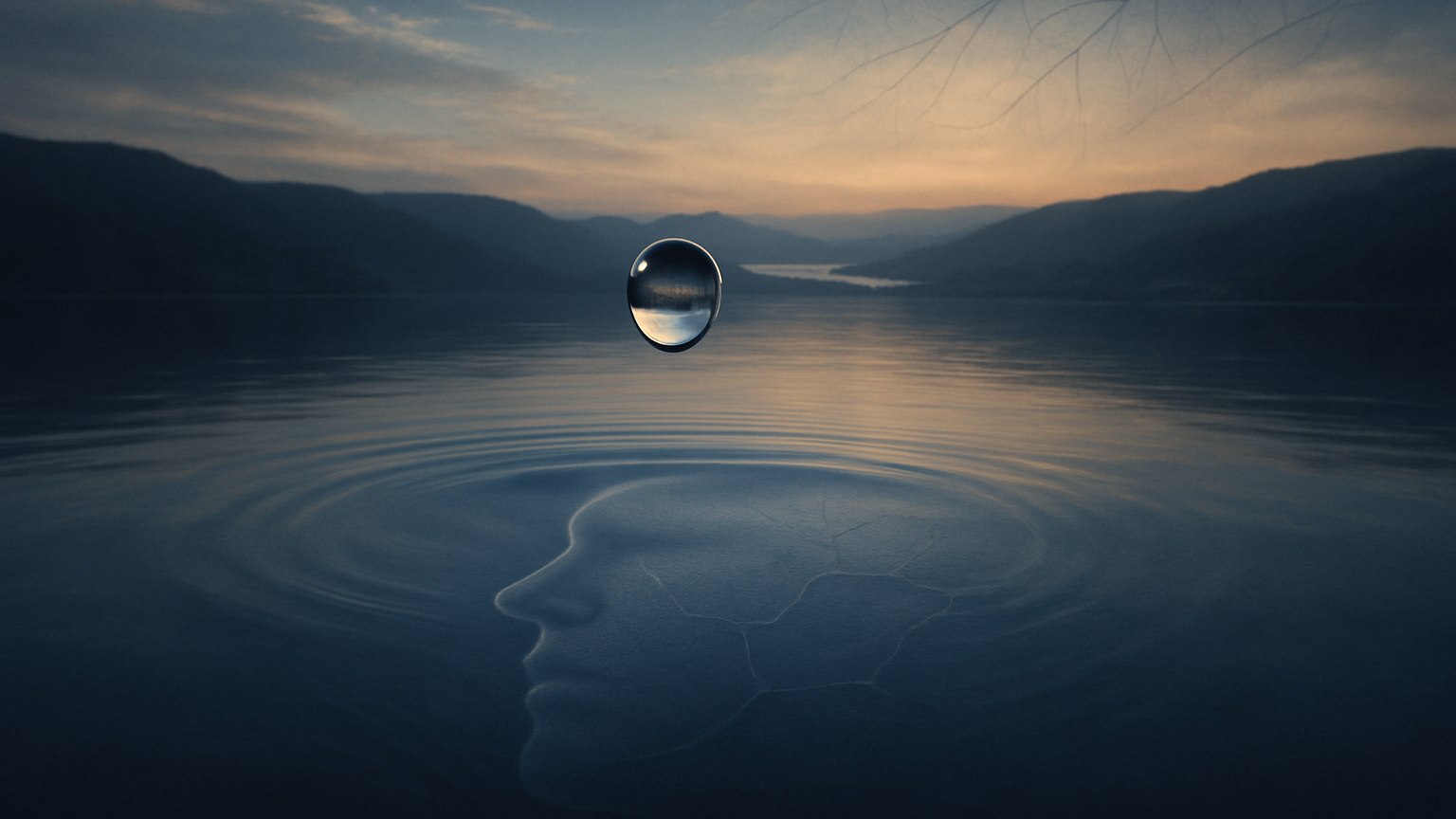
Water moves through almost everything alive. It rises from the ocean, becomes cloud, returns as rain, enters a root, travels through a leaf, passes into fruit, blood, breath, tears, drains, rivers, and eventually the sea again. The hydrologic cycle has no true beginning: sunlight and gravity continually transfer water among atmosphere, land, oceans, underground stores, plants, animals, and cells. In that unbroken circulation, the water in a human body is not simply ours. It is a passing participation in a planetary movement older than any individual life. Water cycle
This is an ordinary fact with an unordinary philosophical consequence. We tend to imagine ourselves as bounded beings: skin draws a line, a name gathers a biography, memory makes a private interior. Yet water quietly ignores the line. It becomes body without becoming property. It leaves body without becoming alien. It links the rain forest to the lung, the glacier to the bloodstream, the ancient sea to the infant’s first drink. An organism may be less like a sealed object than like a whirlpool: recognizable, coherent, temporarily distinct—and inseparable from the flow that gives it form.
That image does not erase individuality. A whirlpool has a real shape, a location, and a history; it can deepen, dissipate, collide, or endure. But its identity is a pattern in movement rather than a possession of permanently fixed material. Perhaps living identity is similar. The body continually exchanges matter with its surroundings, while the person remains intelligible as an ongoing organization of relations. Water makes this difficult truth visible: continuity need not mean sameness of substance. It can mean fidelity of pattern through change.
What could it mean for water to remember?
The phrase “water memory” is often used too quickly, as if memory were one thing. But there are several different questions concealed inside it. At the most literal level, water can bear measurable consequences of contact: temperature, dissolved minerals, gases, contaminants, acidity, isotopic composition, and the presence of other molecules can all make a sample physically different from another sample. In this modest but important sense, water has a history. It has been acted upon, and that action can sometimes be read.
At the molecular level, however, liquid water is not a still archive. Its hydrogen-bond network is extraordinarily dynamic. Ultrafast spectroscopy has shown that structural correlations in neat liquid water decay on femtosecond and picosecond timescales: water is continuously reorganizing itself, not holding a stable molecular portrait of everything that has passed through it. Ultrafast memory loss and relaxation processes in hydrogen-bonded systems The strongest scientific version of the question is therefore not whether water is inert—clearly it is not—but what kind of information, under what conditions, can persist in it, and for how long.
This distinction matters because water is also an active participant in biological memory. A memory in a brain is not generally understood as a message stored inside water molecules. It is embodied in changing networks of cells, synapses, proteins, electrical activity, and chemical signaling—all of which occur in an aqueous environment. Water surrounds proteins, nucleic acids, and membranes; it affects their structure, motion, binding, and function. In living systems, then, water is not the ink in which memory is written, nor merely the paper beneath it. It is closer to the shifting medium that allows the writing, reading, revision, and transmission to happen at all. Hydration of proteins and nucleic acids: Advances in experiment and theory. A review
That suggests a more subtle proposition. Perhaps the deepest significance of water is not that it stores every event as a hidden recording, but that it makes retention amid change possible. Life needs a medium in which molecules can meet, separate, fold, react, transport energy, and form temporary alliances without freezing into permanence. Memory itself requires this paradox. A mind that retained nothing would have no continuity. A mind that could alter nothing would have no learning. Water is an elemental expression of the middle condition: fluid enough for novelty, structured enough for relation.
Claims that water retains impressions of substances after extreme dilution, or responds in a reliable physical way to human intention, belong to a more speculative territory. They have inspired spiritual practice, alternative healing systems, and imaginative theories of resonance. Yet current physical understanding does not establish a reproducible mechanism by which ordinary liquid water preserves such long-term, specific imprints after the originating material is absent. Can water possibly have a memory? A sceptical view This boundary need not make the question spiritually empty. It tells us where one mode of inquiry ends and another begins: an experimental claim asks what can be measured and repeated; a metaphysical claim asks what kind of world might make experience, meaning, and relation possible.
Water as the grammar of relation
Long before molecular spectroscopy, water appeared to philosophers as more than a useful substance. Thales of Miletus, as reported by Aristotle and later tradition, held water to be the originating principle of things—an archē, meaning a source or first principle. Thales of Miletus The claim may not be chemistry in the modern sense, but it is not simply primitive chemistry either. It asks a metaphysical question still alive today: beneath the dazzling diversity of forms, is there a generative continuity from which differences arise?
Water was a compelling answer because it unsettles the opposition between form and formlessness. A river has form but cannot keep it. Ice is stable yet can melt. Steam disappears to the eye while remaining materially continuous with rain and sea. Water seems to say that change is not necessarily annihilation. It is transformation under conditions. For a creature frightened by loss, that is a profound symbol. What vanishes from one visible arrangement may continue in another mode of participation.
Religious imagination has often approached water through this threshold quality: washing as renewal, immersion as passage, springs as gifts, rivers as boundaries between worlds. An Egyptian funerary water jar in the Metropolitan Museum’s collection was made to assure an eternal supply of water for a dead princess—an artifact that shows how intimately water could be joined to ideas of continuance beyond ordinary life. Magical Water Jar of Sithathoryunet with Lid Such symbolism should not be mistaken for laboratory evidence. Its truth, where one finds it, is imaginal and existential: water becomes a language through which humans contemplate death, rebirth, dependence, and return.
Here the idea of “memory” changes register. The water in a ritual bowl may not retain a scientifically demonstrable record of a prayer, but the prayer may alter the person who handles the bowl. Attention changes posture; expectation changes interpretation; repeated action shapes habit; shared ritual gives feeling a social form. In this sense, intention can enter water’s world without requiring water to become a supernatural data-storage device. The water is participant, occasion, mirror, material bond. It gathers a community around a reality no individual can manufacture alone: vulnerability, thirst, mortality, gratitude.
The consciousness question beneath the water question
Why are people drawn to imagine water as conscious, receptive, or sensitive? Perhaps because consciousness itself has something waterlike about it. Experience is never a fixed object. It moves. Sensations arrive and dissolve; memories surface, combine, and alter their emotional color; attention takes the form of what it meets. Yet amid that flow, a recognizable style of presence persists. We call it “I.”
This does not prove that water has subjective experience. Consciousness may depend on forms of biological organization far more elaborate than a liquid. But the analogy can still clarify something. If consciousness is not a little spectator trapped inside the skull but an activity continuously shaped by body, world, language, memory, and encounter, then it resembles a current more than a container. The observer is not outside the observed world in the way a judge stands outside a courtroom. Perception is an event at the boundary where organism and environment become mutually implicated.
Water offers an image for that boundary: not a wall, but a membrane. A membrane separates, certainly, but it also selects, exchanges, communicates, and maintains life precisely by being permeable in the right ways. The philosophical mistake may be to choose between absolute separateness and featureless oneness. Water proposes a third possibility: distinctness through relation. A drop is not the ocean, but it is never made of anything other than the ocean’s own possibility.
From this perspective, the question is no longer simply, “Does water remember us?” A more demanding question appears: what does our dependence on water reveal about the kind of beings we are? Perhaps we are not isolated minds occasionally encountering a world of matter. Perhaps mind, body, and world are overlapping processes of response—different densities of the same fundamental fact that nothing exists entirely by itself.
Water does not settle that metaphysical question. It deepens it. Its molecular structures rearrange with astonishing speed; its planetary circulation spans continents and ages; its presence makes biological complexity possible; its symbolism gives human beings a way to feel continuity where they fear fragmentation. Its “memory” may not be a secret library of every thought ever directed toward it. But water remembers something more visible and, perhaps, more challenging: that life endures not by escaping change, but by learning how to become itself within it.
Sources and references
More to read
10 Lesser-Known Acupuncture Points: A Map of Crossroads, Reservoirs and Hidden Pathways
Beyond acupuncture’s familiar headline points lies a quieter set of locations that reveal how Traditional Chi…

The Afterlife of the Unlived: Do Forgotten Possibilities Still Exist?
An unrealized future can vanish from memory, paper and testimony. But does that erase it completely—or does i…
The Afterlife of the Almost: Do Unlived Futures Still Belong to Us?
Every life is crowded with futures that never arrived: the city not moved to, the apology not made, the work …
Apps to use

Fu Hsi's Name Trigram
Discover the trigram hidden within your name and explore its personality traits, strengths, weaknesses, caree…

Fu Hsi's Octogram
Discover your birth trigram, explore your current life phase, and search past or future phases through Fu Hsi…

Chinese Zodiac
Discover your Chinese zodiac animal and element from your birth date, and explore its traditional traits, str…